
Terror trails
IED blast kills nine in Borno; 43 killed in Benue attacks. Plateau sees 12 dead from herder violence, with six more killed in separate attacks.

Nine travellers were killed following an Improvised Explosive Device (IED) attack at a bus stop in Mairari village, Borno State, with many others injured. Speaker Abdulkarim Lawan blamed terrorists monitoring the area and urged the military to reclaim Guzamala LGA. In Benue State, 43 people were killed in attacks on Gwer West and Apa communities. In Plateau State, the death toll from a herder attack in Bokkos LGA rose to 12. Six more people were killed in separate attacks in Bassa and Mangu LGAs, with several others injured. Houses were also burned in the violence.
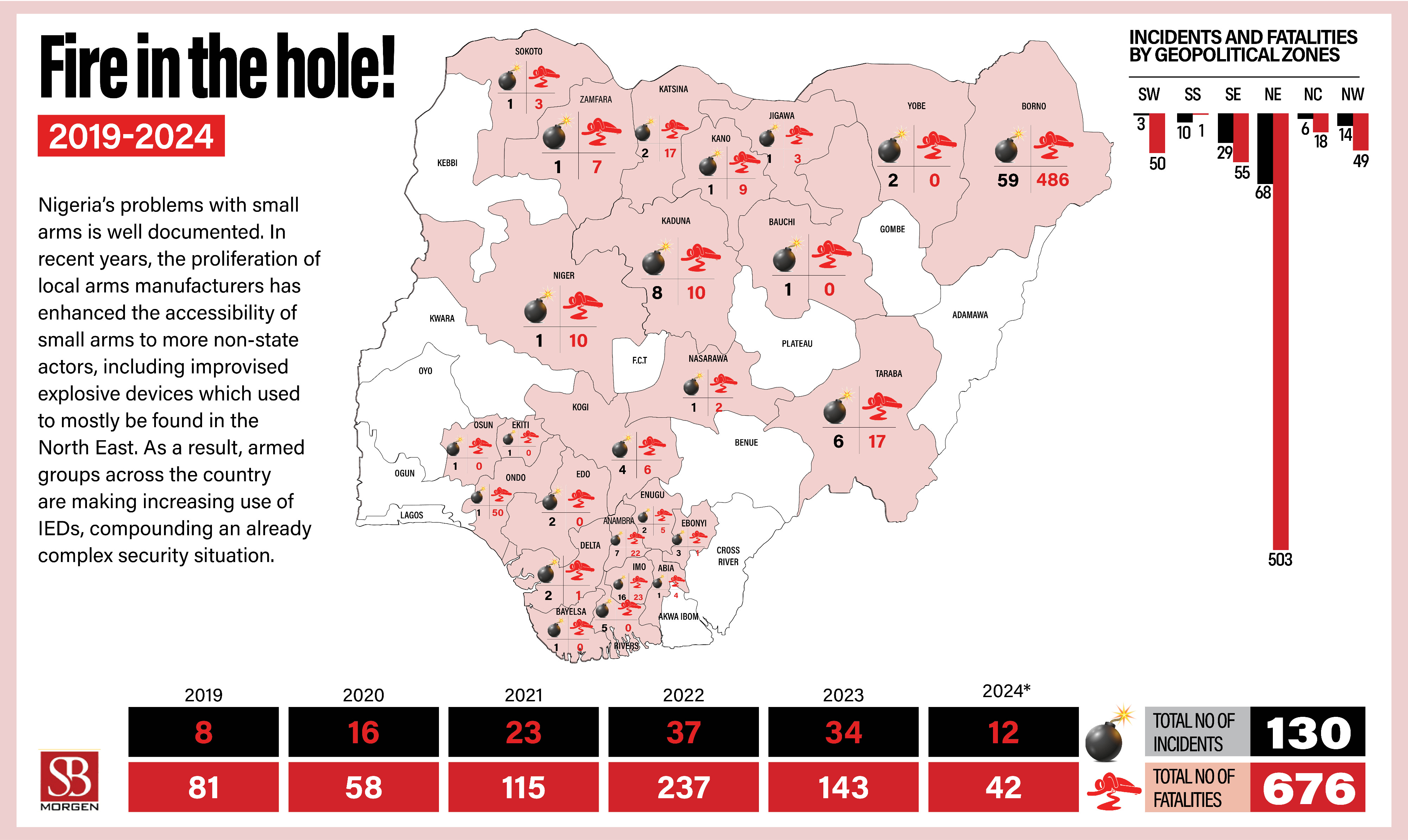
The use of improvised explosive devices (IEDs) by armed groups in Nigeria has surged beyond official reports, inflicting devastating harm on civilian populations. Action on Armed Violence (AOAV) reported a 177% increase in civilian casualties from IEDs in 2024, with 90% of victims being civilians. Alarmingly, 96% of civilian deaths from suicide bombings across West Africa occurred in Nigeria. This trend, likely persisting into 2025, saw 411 civilian deaths from mines and IEDs in Nigeria's northeast in 2024—the highest since 2020—largely due to Boko Haram and ISWAP employing sophisticated explosives, including drones. Whilst reputable sources like AOAV and the UNODC (which highlights IEDs exacerbating violence and damage) primarily rely on English-language media, their data aligns with ACLED's conflict tracking, confirming widespread civilian targeting.
The Nigerian military's inability to reclaim Guzamala in Borno State highlights wider strategic deficiencies, allowing insurgents to maintain control and intensify IED attacks. Despite deploying mine-resistant armoured protected (MRAP) vehicles, the military's "super camp" strategy—fortifying bases whilst ceding rural areas—has left civilians vulnerable. This pattern of insecurity is replicated elsewhere: in Benue, suspected herders killed 61 people in Gwer West and Apa on 31 May and 1 June 2025, whilst in Plateau, over 100 civilians died in Bokkos and Bassa in April 2025. These attacks have destroyed schools and clinics, worsening displacement.
These incidents underscore the military's failure to secure these regions, despite a recent, widely scrutinised announcement to relocate headquarters to Benue, where 20 of 23 local government areas have seen sustained violence. The human cost is immense: 450,000 displaced in Benue and 65,000 in Plateau, with hundreds of villages sacked across both states. Civilians continue to bear the brunt of an unevolving security architecture. The military’s reactive tactics, including a September 2024 airstrike in Kaduna that killed 24 civilians, have eroded public trust and failed to address underlying issues such as land disputes and weak governance.
A citizen-centred approach to security is crucial, starting with an honest appraisal of the state's retreat that has allowed these crises to flourish. The violence in Borno, Benue, and Plateau is a grim reminder of Nigeria’s complex security crisis. Despite federal claims of progress, insurgents continue to surveil, plan, and execute attacks. Guzamala's continued occupation by insurgents highlights the disconnect between government narratives and local realities, with the absence of state authority creating fertile ground for extremism and resentment.
The common thread in these tragedies is a systemic failure to secure rural communities. Whether perpetrated by jihadist insurgents, armed herders, or communal militias, the outcome is consistent: death, displacement, and destruction. Many victims, simply trying to resume daily life, have paid with their lives, underscoring the brokenness of the security infrastructure.
These attacks are not random but symptoms of deeper structural issues. Nigeria's security challenges now involve ideological extremism, ethno-religious tensions, land and resource disputes, and the criminal exploitation of ungoverned spaces, creating a blurred web where distinctions between ideology, identity, and criminality are increasingly difficult to make.
The state’s response remains contradictory. Whilst federal authorities proclaim military victories, recurring attacks in supposedly secure zones reveal a profound gap between strategy and outcomes. Local leaders, like Speaker Lawan, continue to plead for intervention in areas that should already be under control. Without sustained efforts to reclaim territory and restore governance, the cycle of violence will persist.
Ultimately, the tragedy extends beyond lost lives; it exposes Nigeria’s fraying social fabric. Communities are being hollowed out, ancestral lands abandoned, and faith in institutions shattered. For many, the Nigerian government appears a distant abstraction rather than a guarantor of security or rights. What is needed is more than tactical operations or rhetorical pronouncements; Nigeria faces a national emergency that demands courage, clarity, and the political will to rebuild its security infrastructure from the ground up. Every village razed, every farm abandoned, and every life lost should serve as a national alarm—one that, for now, continues to ring unanswered.