

Nigeria’s kidnap industry has undergone a fundamental shift. Between July 2025 and June 2026, no fewer than 7,825 people were abducted across 1,713 kidnap and kidnap-related incidents, a 66% increase in victims from the previous cycle, with at least 1,142 people killed.
But the numbers that matter most tell a different story.
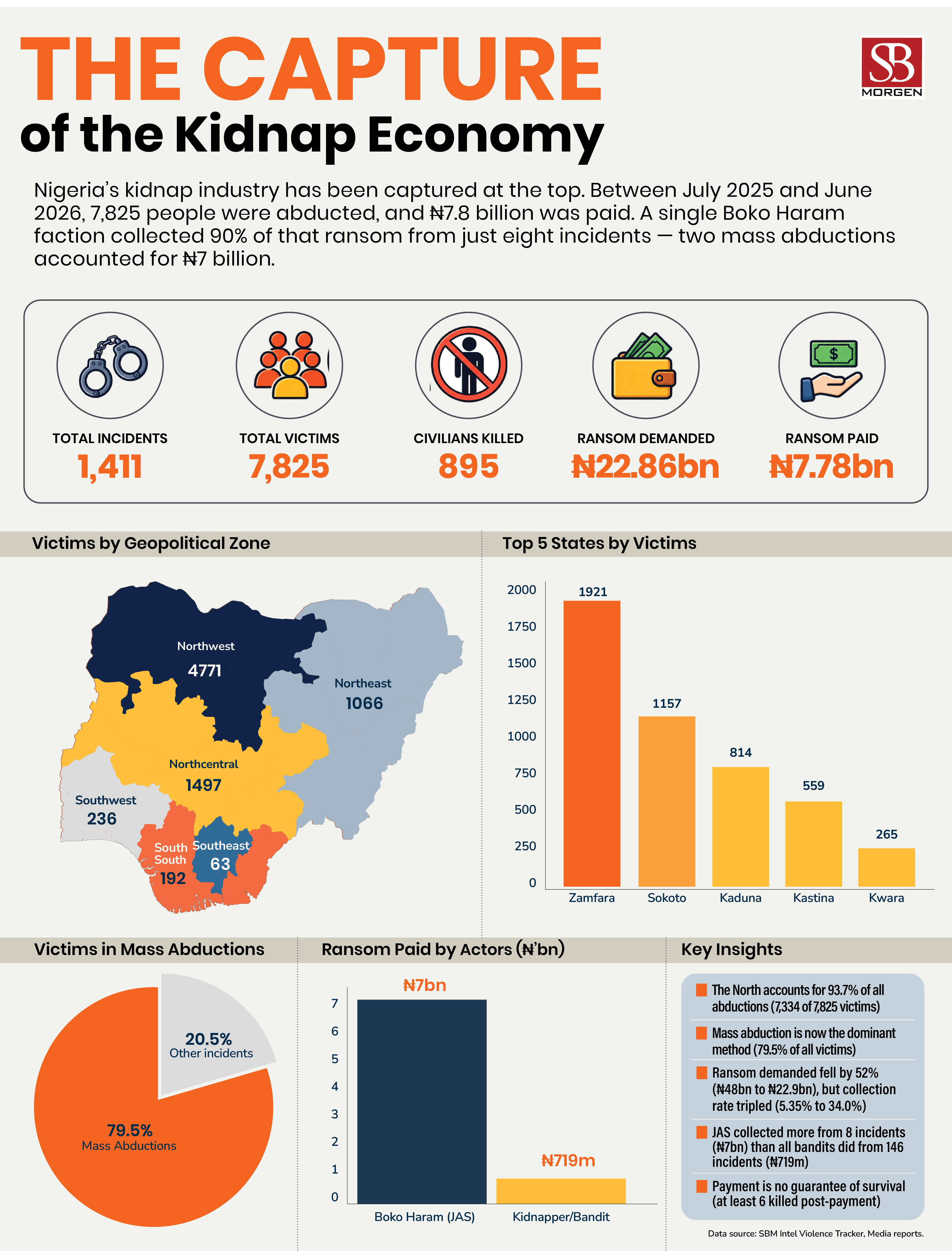
The economics have inverted. Ransom demanded fell from ₦48 billion to ₦22.9 billion, yet the amount actually paid more than tripled, from ₦2.56 billion to ₦7.78 billion. The collection rate jumped from 5.35% to 34%. This is not because kidnappers are getting better at negotiating. One group, the Jama’atu Ahlis Sunna Lidda’awati Wal-Jihad (JAS) faction of Boko Haram, collected 90% of all ransom paid from just eight incidents.
Two abductions drove the year’s total: the ₦5 billion ransom for 416 captives taken from Ngoshe, Borno, and the ₦2 billion paid for 315 pupils and staff abducted from St Mary’s School in Papiri, Niger. Between them, these accounted for ₦7 billion, almost the entire national ransom bill.
The geography remains unchanged. The Northwest leads in incidents, victims and deaths. Zamfara recorded 236 kidnapping incidents and 1,921 victims, nearly a quarter of the national total. The North accounts for 93.7% of all abducted persons, while the South’s share has shrunk to just 6.3%.
Mass abduction is now the dominant mode. Four in five victims were taken in group seizures. Zamfara alone recorded 92 mass abductions, followed by Sokoto with 76. School abductions have resurged, with the Papiri attack reviving a tactic whose costs ripple through education, farming and public trust.
Payment is no guarantee of survival. In at least six cases, victims were killed after ransom was paid. Ransom-bearers are increasingly being abducted themselves. And in 14 incidents, kidnappers demanded goods, motorcycles, phones, food and fuel, again showing an economy calibrating to the thin cash resources of its victims.
The strategic implication is stark. The everyday kidnap economy — bandits and criminal gangs — demanded ₦13.5 billion but collected just ₦719 million, a 5.3% collection rate. JAS, by contrast, demanded ₦9.2 billion and collected ₦7 billion, a 76% rate. Measured by what was demanded, the kidnap economy is a crime of the many. Measured by what was actually paid, it is dominated by a single terrorist organisation.
Breaking this cycle demands two actions: disrupting the financial flows that now underwrite insurgency, and addressing the economic desperation that supplies its foot soldiers. Without a coordinated strategy that targets both the profitability of the crime and its roots, Nigeria risks entrenching kidnapping not merely as a criminal industry but as a funding mechanism for the very groups that most threaten its stability.