
The old guard
President Biya reshuffles Cameroon’s military amid his re-election bid, while opposition leader Kamto joins the race alongside 80 candidates, including seven women.

Cameroonian President Paul Biya has enacted a major military reshuffle, promoting key personnel across the army, air force, and navy shortly after announcing his re-election bid. Analysts view this as a strategic move to consolidate military support ahead of the October 2025 elections. Opposition leader Maurice Kamto confirmed his candidacy under the APC coalition, aiming to revitalise opposition momentum amid political tension. A record 81 presidential candidates submitted applications before the deadline, with several switching party affiliations. Only seven are women, including Eliane Eboutou and Geneviève Zeh Amvene. The electoral council will finalise the approved list 60 days before the polls.
President Paul Biya’s recent military reshuffle, enacted shortly after his announcement to seek an eighth term at the age of 92, appears to be a calculated move aimed at consolidating power ahead of Cameroon’s October 2025 presidential election. By promoting loyal officers and reassigning command positions across key units—including the elite Rapid Intervention Battalion (BIR) and various presidential military advisory roles—Biya is clearly reinforcing internal loyalty, deterring potential dissent, and shoring up the security of his regime. The timing and extensive nature of these changes strongly suggest a strategic focus on his political survival rather than fostering national cohesion, particularly given the country's ongoing separatist unrest in the Anglophone regions and persistent Islamist insurgencies in the north.
This reshuffle reflects deeper issues within Cameroon, indicative of militarised governance, profound institutional fragility, and a concerning erosion of democratic principles—the lack of transparent succession planning further compounds Cameroon’s fragile stability. The announcement of at least 81 presidential aspirants, whilst signalling a popular appetite for change, also underscores the significant fragmentation of the opposition. High-profile defections—such as former Biya allies Issa Tchiroma Bakary and Bello Bouba Maïgari—indicate growing cracks within the ruling CPDM, particularly in northern constituencies, which account for over two million crucial voters.
While the entry of seasoned opposition figures like Maurice Kamto (MRC), Cabral Libii (CPNR), Akere Muna (Univers), and Hermine Patricia Tomaïno Ndam Njoya (UDC) certainly broadens the political field, the opposition remains deeply divided. Legal constraints, including stringent party representation thresholds and a single-round voting system, have consistently hindered efforts to unify opposition forces. Despite Kamto’s persistent push for a common front, rivalries and internal divisions continue to plague their efforts, further compounded by perceived state interference and a strategic proliferation of smaller opposition parties—reportedly a government tactic designed to dilute the collective strength of the opposition.
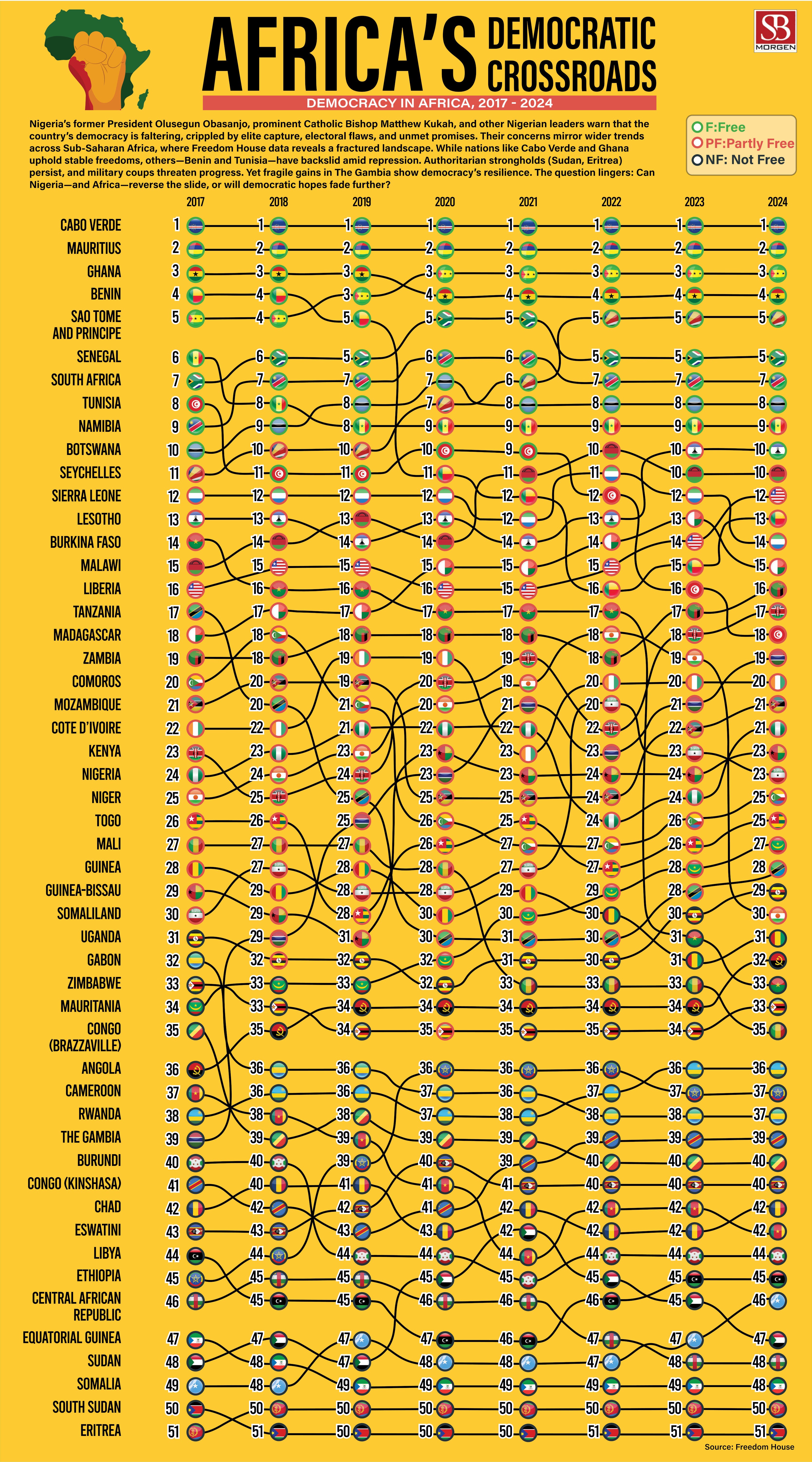
The government’s decision to delay legislative and municipal elections to 2026 further marginalises key challengers, notably Kamto’s MRC, which currently holds no parliamentary representation after boycotting the 2020 elections due to allegations of fraud. The crackdown on opposition groups has intensified, with Human Rights Watch and other observers documenting a pattern of arrests, protest bans, and restrictions on press freedom. In March 2024, two coalitions, including the APC (Alliance for Political Change), were declared illegal, effectively forcing Kamto’s alliance underground. Cameroon’s democratic space continues to shrink, starkly reflected in its Freedom House ranking as “Not Free,” with a score of 15/100, including a political rights score of 6/40 and a civil liberties score of 9/60.
Biya’s remarkable longevity in office is partly attributable to the 2008 removal of presidential term limits. His 2018 re-election—secured with 71.28% of the vote—was widely marred by fraud allegations, continuing a consistent pattern of contested elections dating back to 1992. Voter turnout has steadily declined over the years—from 80.4% in 1992 to 53.3% in 2018—reflecting widespread disillusionment among the populace.
This military reshuffle likely serves two primary purposes: first, to pre-empt any internal dissent and explicitly ensure loyalty among military ranks; second, to prevent a post-election scenario akin to Gabon’s 2023 military-led ousting of President Ali Bongo. Crucially, these changes do not appear to enhance military effectiveness against existing insurgent threats. Boko Haram has continued to make territorial gains in the Far North, while the protracted conflict in the Anglophone regions remains frozen but deeply unresolved. Despite relatively strong macroeconomic indicators compared to its Central African neighbours, Cameroon faces acute youth unemployment and widespread social discontent, particularly exacerbated in conflict-affected zones.
The electoral body, Elections Cameroon (ELECAM), consistently lacks true independence, being staffed mainly by individuals with discernible ties to the ruling party. Oversight by Paul Atanga Nji, the Minister of Territorial Administration and a staunch Biya loyalist, further undermines any confidence in electoral neutrality. Nicknamed the “Moulinex National” for his hardline stance against dissent, Atanga Nji embodies the regime’s increasingly repressive posture. In sum, Biya’s reshuffle effectively consolidates his power but does little to address the fundamental structural weaknesses undermining democratic governance, national security, and public trust. The inherent risk is not merely electoral illegitimacy, but the perilous deepening of systemic instability in one of Central Africa’s most geopolitically pivotal states.