
The SBM Voter Sentiment Tracker: How Nigeria may vote
Hunger, insecurity and political chaos grip Nigeria. SBM’s first voter survey shows Tinubu is weak, Obi is popular, but turnout will decide.

It is June 2026. The United Nations warns that 35 million Nigerians could face acute hunger between June and August, more than the population of many African countries. Federal workers have rejected a proposed ₦100,000 minimum wage, calling it a “Greek gift” and threatening an indefinite nationwide strike. In Kaduna, armed bandits stormed a mosque during early morning prayers, killing one worshipper and abducting several others. In Katsina, a retired major general and his wife were dragged from their vehicle into the forest; the gunmen may not have even known who they had grabbed.
In the Southeast, the army arrested an IPOB informant allegedly spying on troop movements. In the Southwest, protesters took to the streets after the abduction of schoolchildren. The opposition coalition that once promised a united front against President Tinubu has collapsed. Peter Obi and Rabiu Kwankwaso defected from the ADC to form the NDC, leaving the coalition in disarray and opposition figures trading accusations of betrayal.
Against this backdrop of economic collapse, security chaos and political fragmentation, SBM Intelligence conducted its first Voter Sentiment Tracker survey: 829 respondents across all six geopolitical zones. The data reveals a country on the edge.
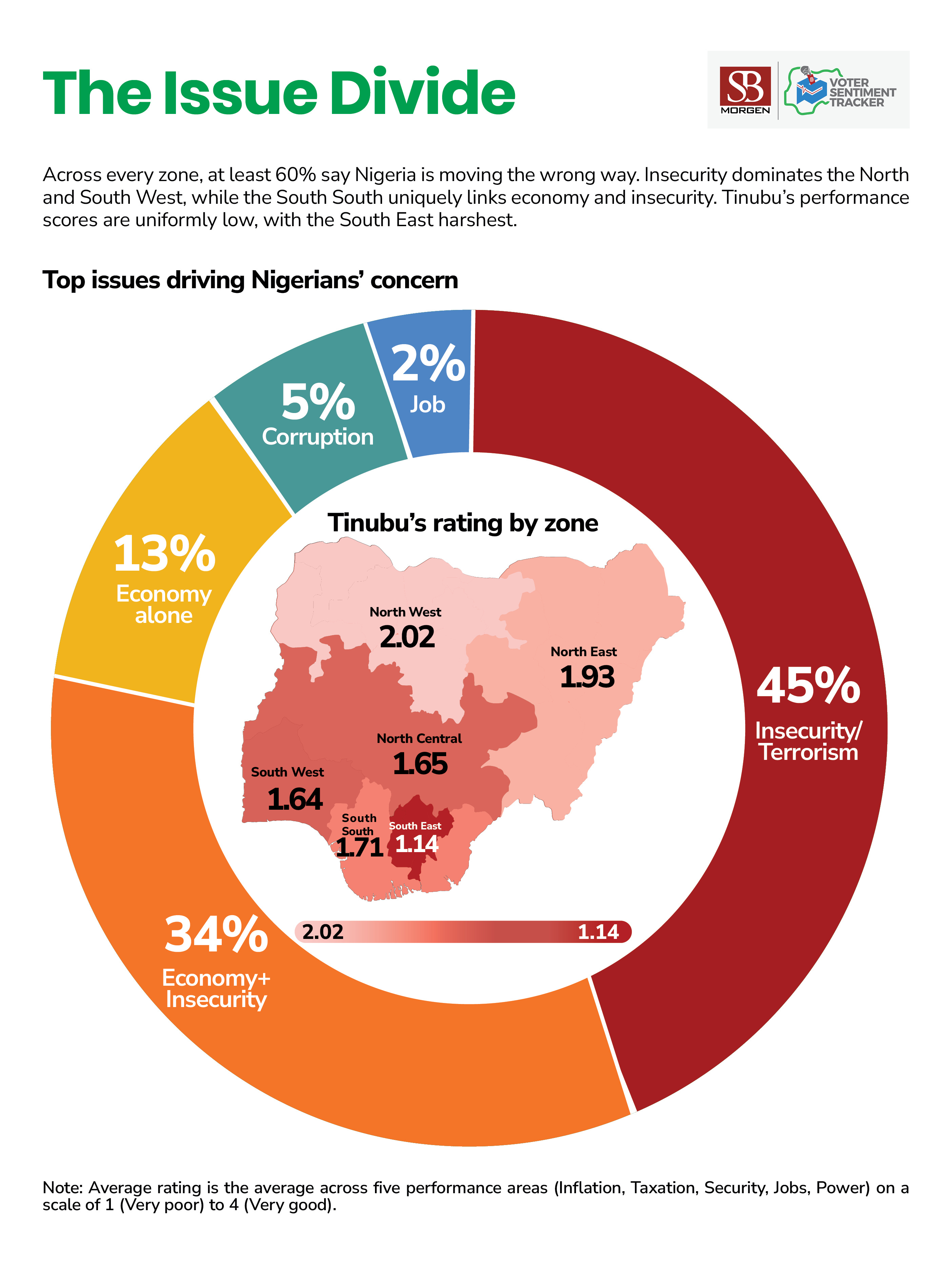
President Bola Tinubu enters the 2027 race with the weakest favourability position of any candidate in this survey, a net score of -58.5 nationally. His handling of inflation, security, jobs and power is rated below “poor” in every zone except the Northwest. Across five policy areas, his average rating never reaches 2.1 out of 4.
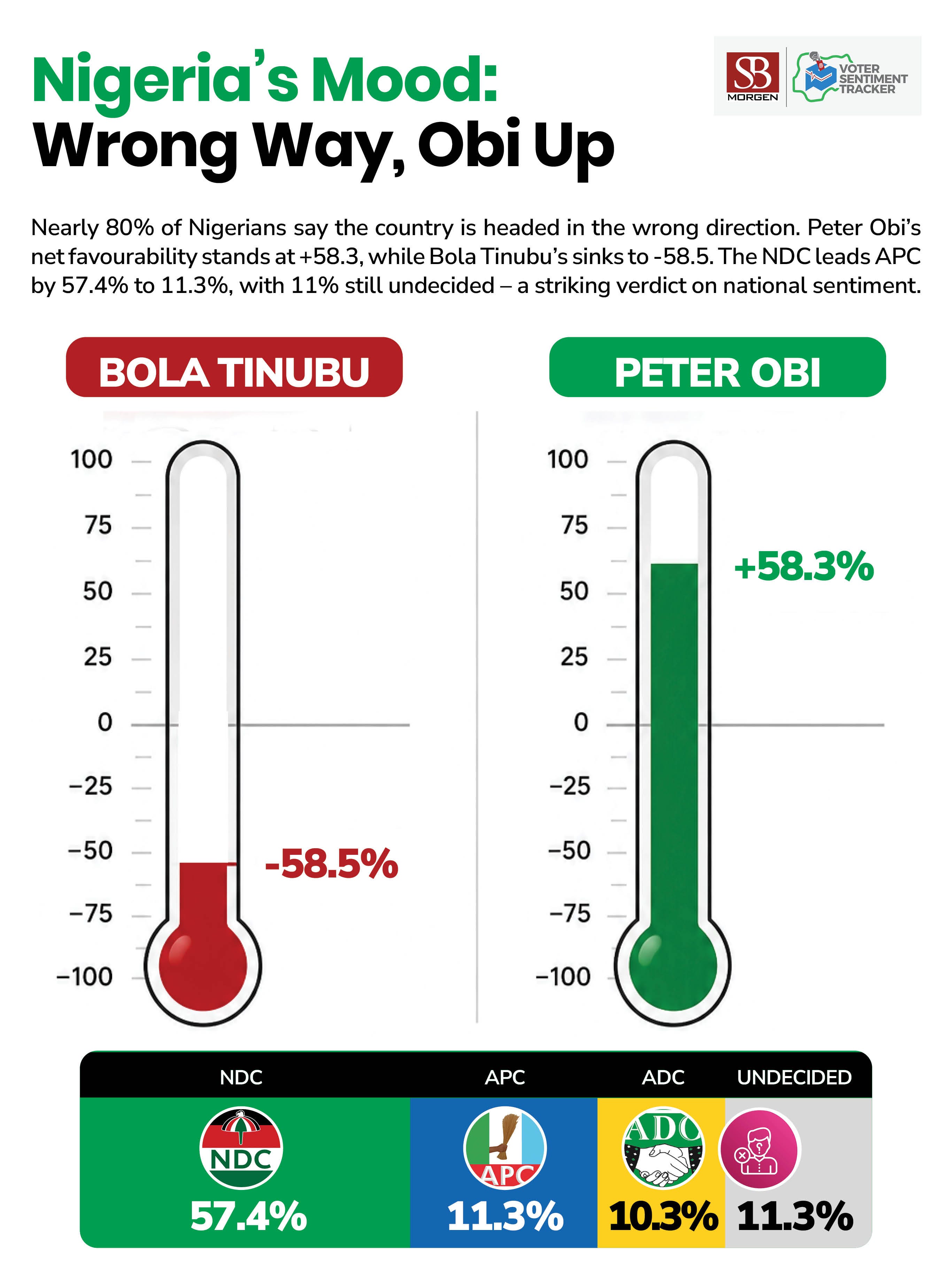
Peter Obi, by contrast, records a net favourability of +58.3, the only candidate in positive territory. He leads in every zone except the Northeast, and even among Southwest respondents, President Tinubu’s home base, Obi’s net favourability (+28.9) outruns the president’s (+15.1).
But favourability is not the same as victory.
The NDC’s vote share jumps from 32% in a low-turnout scenario to 65% in a high-turnout one. The zones where high-turnout intention is strongest, Southeast (87.4%), South-South (82.9%) and Northwest (82.4%), show different dynamics when it comes to new PVC registrations. The South-South leads on post-2023 registrations among our respondents (49%), suggesting motivated new entrants driving both numbers. In the Southeast, high turnout intent is driven by an already-registered electorate rather than new sign-ups (33% new registrations). The Northwest, despite strong turnout intention, has the second-lowest new registration rate (18.6%), suggesting that its mobilisation is built on an established voter base rather than fresh registration. What unites all three zones is the determination to vote; the source of that determination differs.
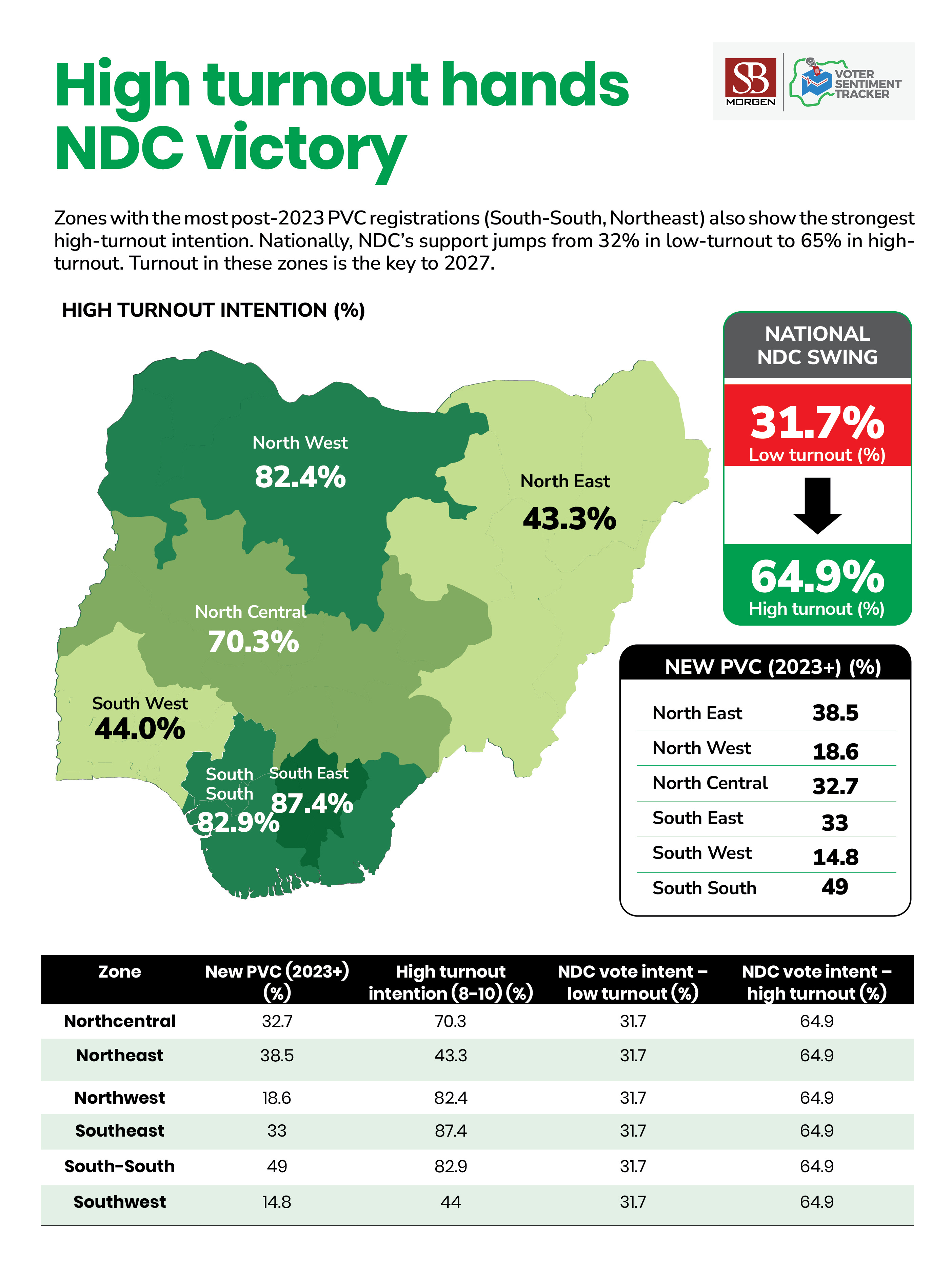
The Southwest and Northeast are the two zones where the outcome is most open, but for entirely different reasons. The Southwest has the lowest high-turnout intention of any zone (44%), the largest undecided share among major zones (23%), and the only significant APC vote base (22%), yet its sheer size and President Tinubu’s incumbency advantage make it structurally pivotal. The Northeast, by contrast, is not apathetic so much as fragmented: 43.3% fall in the high-turnout band, but the vote splits three ways: ADC at 23.1%, APC at 17.3%, NDC at 13.5%, with 16.4% still undecided. While the Southwest’s uncertainty stems from a Yoruba electorate that has yet to decide whether to defend its president or defect, the Northeast’s uncertainty stems from the genuine absence of a dominant opposition figure. Both zones could determine the margin of victory; neither will be won the same way.
This is the state of the country. What follows is the data.