
Three BDCs get US attention
The US has sanctioned a Nigerian national and three currency exchange firms for allegedly channelling funds to ISIS.

The United States has sanctioned a Nigerian national, Mukhtar Adamu Muhammad, and three Nigeria-based companies for allegedly helping facilitate financial transactions linked to the Islamic State of Iraq and Syria (ISIS). The companies affected are Generation Currency Bureau De Change Limited and Nine to Nine Exchange Bureau De Change Limited in Lagos, and Manhattan Bureau De Change Limited in Kano. According to the U.S. State Department, the sanctions are part of a broader effort targeting a network of individuals and entities across Europe, the Middle East, and West Africa accused of enabling ISIS to move funds through money exchange businesses and cryptocurrency transactions. The measures were imposed under Executive Order 13224, which targets terrorists and their supporters.
The US sanctions on Mukhtar Adamu Muhammad and three bureau de change operators represent more than routine watchlist additions. They are the latest phase of a coordinated US-Nigeria effort to dismantle jihadist financial and operational networks across West Africa, while revealing the limits of Nigeria’s counter-terrorism financing progress.
The sanctions follow a joint US-Nigerian military operation that killed Abu-Bilal al-Minuki, a key Islamic State leader and architect of ISWAP’s financing. His death, years in the making, reflects deep intelligence and military cooperation. By targeting both a commander and the financial channels sustaining him, both countries are pursuing a dual strategy to weaken ISIS’s ability to regenerate, recruit and move funds.
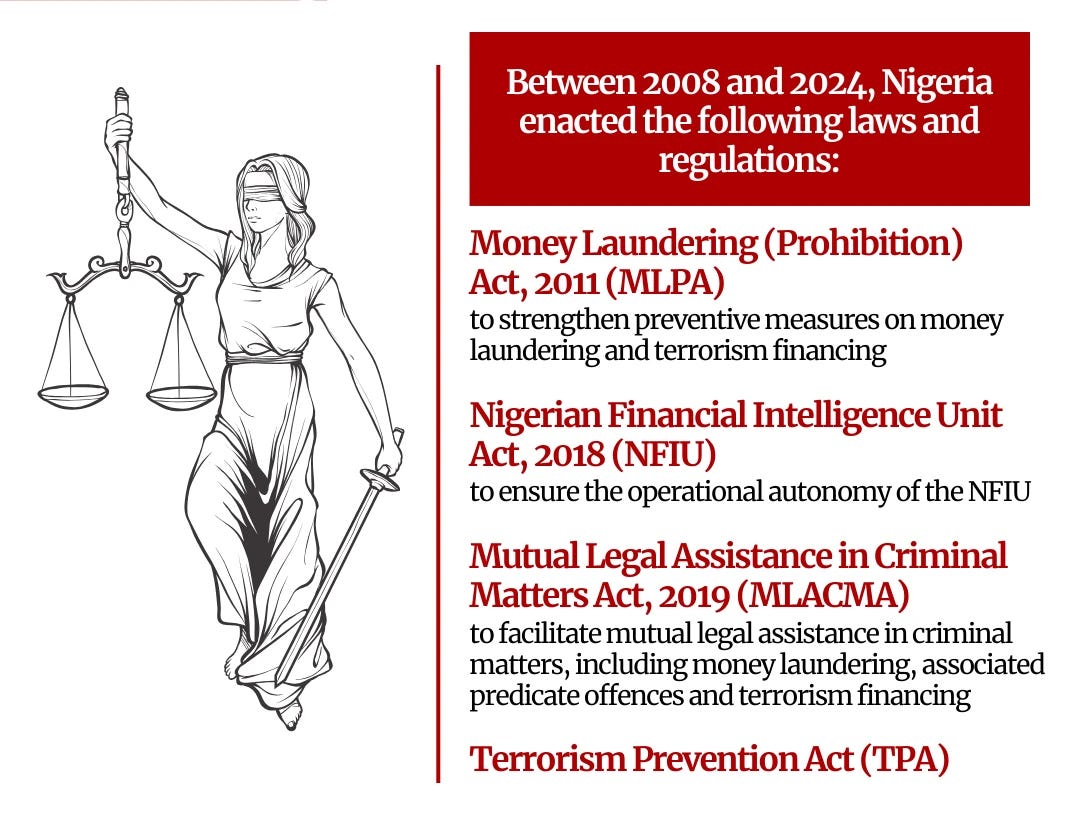
The timing is significant. Nigeria exited the FATF grey list in 2025 after anti-money laundering reforms. The latest US designations, however, reveal a gap between regulatory compliance and effective enforcement. Nigeria has announced terrorism financing designations for years, but prosecutions have remained rare. Without convictions, networks can simply reorganise. The designation of bureaux de change operators in Lagos and Kano suggests vulnerabilities remain embedded in parts of Nigeria’s financial system.
Yet focusing on financial facilitators overlooks a larger reality. ISWAP has built a sophisticated revenue model based on taxation, extortion, control of trade routes, livestock levies, agricultural production and kidnapping. Estimates suggest the group generates tens of millions annually, with some analyses putting broader taxation revenues at well over $100 million. These resources sustain operations across Niger, Chad, Mali and Burkina Faso, effectively making Nigeria a financial hub within the wider Islamic State network.
The challenge is growing more complex in northwestern Nigeria. Groups such as Lakurawa bridge local banditry and transnational jihadist movements. Both Islamic State-affiliated factions and al-Qaeda-linked JNIM are expanding into areas with weak state authority. Recent clashes between rival jihadist groups in Kebbi highlight how the region is being drawn into the Sahel’s wider conflict dynamics.
This is why the latest sanctions extend beyond the named individuals. They reflect a growing recognition that terrorism financing, insecurity and governance failures are interconnected. Financial sanctions can freeze assets and increase costs. Joint military operations can eliminate leaders. Neither fully addresses the conditions that allow these groups to thrive.
The deeper contest is over territory, economic control and state presence. Jihadist groups exploit ungoverned spaces and weak institutions to build alternative systems of taxation, security and authority. Until those governance gaps are addressed, financial sanctions will remain an important but incomplete tool. The United States and Nigeria may be dismantling individual networks, but the broader challenge is ensuring that the state, not extremist groups, becomes the dominant provider of security, economic opportunity and legitimacy across Nigeria’s most vulnerable regions.