
Three chefs and a forest lab
Nigeria’s NDLEA seized $363m of drugs and chemicals in its biggest meth lab bust, arresting three Mexicans.

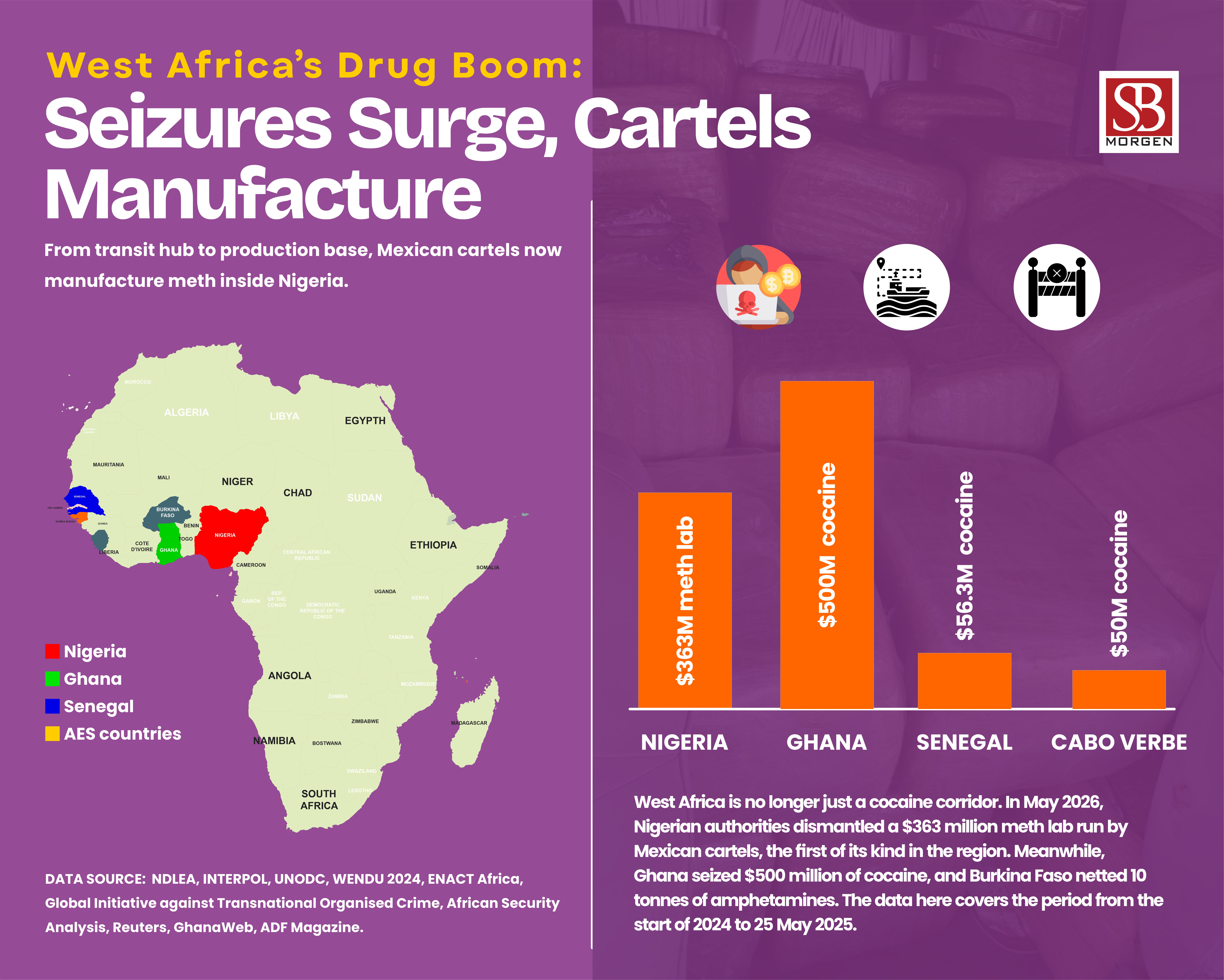
Nigeria’s anti-drug agency, the NDLEA, said it uncovered the country’s biggest meth operation, seizing drugs and chemicals worth about $363 million. Raids in Ogun and Lagos states found a hidden laboratory inside the Abidagba forest. Officers arrested ten suspects, including three Mexicans who worked as meth “cooks.” They recovered 2.4 tons of methamphetamine and large amounts of production chemicals. NDLEA chairman Mohamed Buba Marwa said months of intelligence work led to the raid. He said foreign involvement in Nigeria’s drug trade is growing.
Nigeria’s drug problem runs deep and is getting worse, but it is not an isolated crisis. Across West Africa, drug trafficking and production are reshaping economies and challenging weak institutions. The 2018 National Drug Use Survey, backed by the UNODC, remains the best baseline for Nigeria. It found that 14.4 percent of people aged 15 to 64, about 14.3 million Nigerians, had used drugs in the previous year, nearly three times the global average. Cannabis led consumption, followed by non-medical opioids such as tramadol and codeine. Nearly three million Nigerians suffer from drug use disorders.
Since then, methamphetamine production has grown sharply. UNODC and NDLEA reports show a clear rise in local manufacturing capacity since 2020. Nigeria has shifted from a transit country to an active production hub for synthetic drugs destined for local markets, Europe and Asia. The latest bust, 2.4 tons of meth and precursor chemicals worth about $363 million, with Mexican technicians involved, fits this pattern. In 2024 alone, Nigeria seized 2.6 million kilograms of drugs nationwide, mostly cannabis, and made 18,500 arrests.
But Nigeria is only part of a regional surge. Across West Africa, drug seizures have skyrocketed. In 2024, Burkina Faso seized 10 tons of amphetamines in a single INTERPOL operation. Cape Verde intercepted 1.6 tons of cocaine worth $50 million. Senegal made multiple cocaine busts worth $56 million. Guinea-Bissau, a long‑known narco‑state, seized 78 bales of cocaine from a plane coming from Venezuela. Ghana set records in early 2025, seizing 4.5 tons of cocaine in two truck busts worth $500 million, the largest in the country’s history. The region is no longer just a transit corridor, but is slowly becoming a production base and a growing consumer market.
The geopolitical implications are now impossible to ignore. South American cartels, Mexican and Brazilian, are actively setting up manufacturing bases in West Africa, attracted by weak governance, porous borders and light enforcement. The NDLEA’s May 2026 bust of a meth lab in Ogun State, staffed by Mexican “cooks”, confirms that cartels are no longer just shipping drugs through the region; they are producing them on African soil. Mexico’s Sinaloa and CJNG cartels are now operating across West and Southern Africa, and Brazil’s PCC and Comando Vermelho have established supply chains linking Latin American producers to African ports, using the Gulf of Guinea as a key corridor. Analysts say this is a structural shift in global trafficking. Under pressure from stricter enforcement in the Americas, cartels are relocating manufacturing to jurisdictions where risk is lower and returns are opaque. West Africa offers exactly that mix: weak institutional resilience, entrenched trafficking corridors and security forces that cannot keep up. This is a convergence of organised crime and fragile governance, not just a law enforcement failure. Without a coordinated regional and international response, West Africa risks becoming a permanent cornerstone of global synthetic drug production.
Having said this, high‑profile operations such as the NDLEA’s bust can give drug enforcement agencies strong headlines and short‑term credibility, but will deliver limited long‑term impact. New laboratories keep appearing in remote forests across Nigeria and the Sahel. Street availability and prices show no sustained decline. Domestic consumption continues to rise. Agencies like Nigeria’s NDLEA excel at supply‑side seizures but struggle with the bigger picture. Across West Africa, the approach remains heavily enforcement‑oriented. Demand reduction, prevention and treatment are badly neglected. Treatment access is extremely low. Only a tiny fraction of those in need of help, particularly women and girls, receive any care.
Corruption within law enforcement, weak precursor chemical controls, porous borders and poor inter‑agency coordination allow drug networks to adapt quickly. High‑level complicity often protects major players. Socioeconomic drivers, such as youth unemployment, fuel both supply and demand across the region. The emergence of AES countries (Burkina Faso, Mali, Niger) outside ECOWAS has further complicated intelligence sharing and joint operations.
These repeated large seizures create an illusion of progress without addressing root causes. Until West African governments invest seriously in treatment infrastructure, community prevention programmes, tighter monitoring of chemical imports, and the political will to tackle complicity at higher levels, operations like the recent one will remain tactical wins in a strategic battle the region is losing. West Africa’s role in the global drug economy grows more sophisticated each year. Enforcement alone has so far failed to reverse the trend.