
Tinderbox
Ammunition explosion at Giwa Barracks (Borno) followed Boko Haram attack (Yobe) and bandit killings (Bauchi), highlighting widespread insecurity in Nigeria.

An explosion occurred at Giwa Barracks in Maiduguri, Borno State, on Wednesday night, caused by ammunition detonated by a fire, possibly due to high temperatures. The facility reportedly holds former Boko Haram fighters. Separately, suspected Boko Haram and ISWAP insurgents attacked a military base in Bunigari, Yobe State, killing at least four soldiers in a fierce battle that lasted hours before reinforcements arrived. Meanwhile, at least 19 people were killed in a suspected bandit ambush and livestock rustling in Bauchi State's Gwana district on Sunday morning. The Bauchi police confirmed the incident, with investigations and security operations still ongoing.
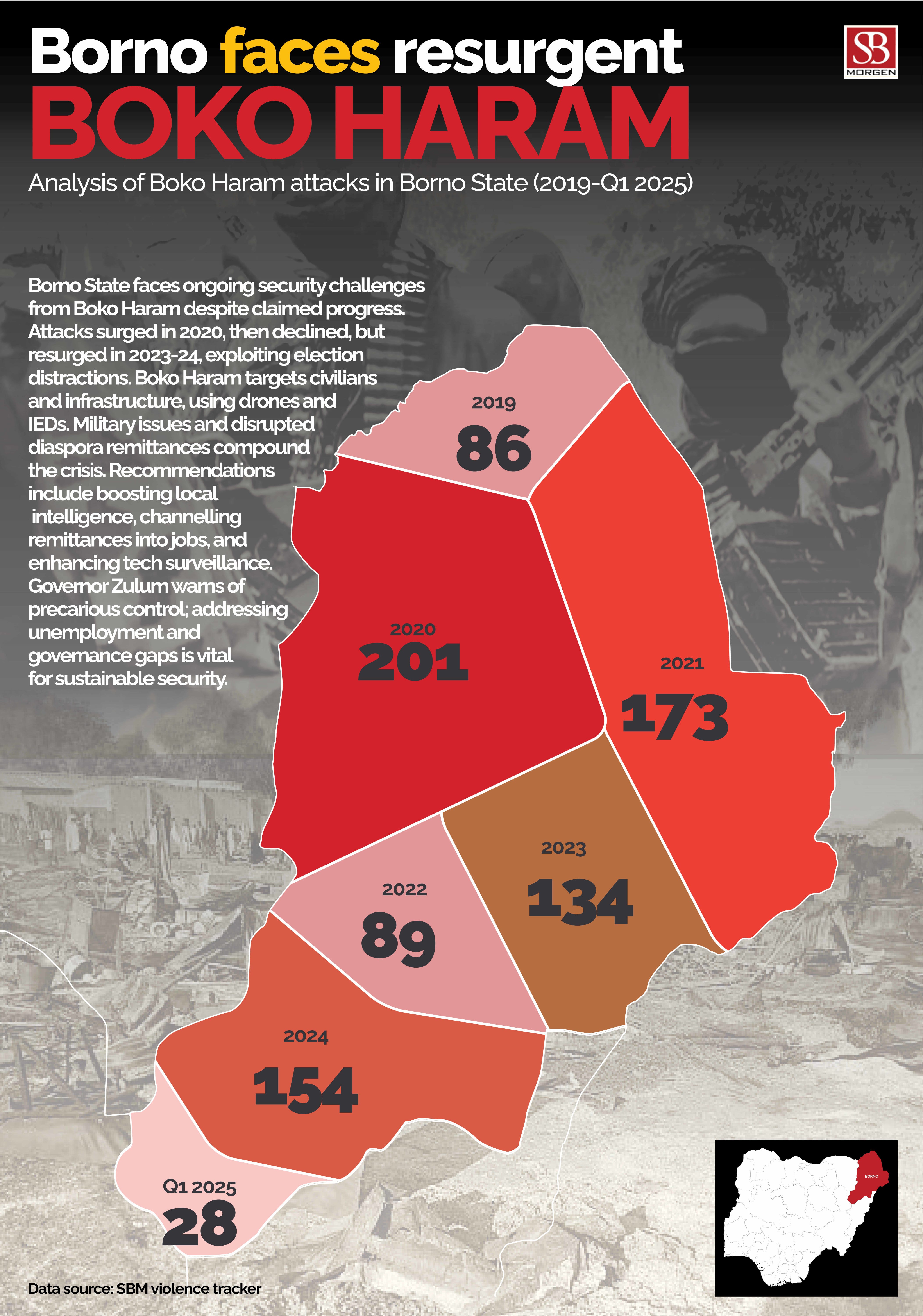
The devastating assault on Buni Gari has confirmed the warnings repeatedly sounded by Borno’s political and traditional leaders about deteriorating security. Just weeks before the attack, Governor Babagana Zulum had raised alarms over resurgent terrorist activity, while the Shehu of Borno claimed at least three local government areas were under insurgent control—an assertion the military disputes. Yet with each new attack, that denial grows harder to sustain.
The Buni Gari raid marks the 13th attack on military bases in Borno or Yobe since ISWAP launched its renewed offensive in October 2024. These relentless strikes, which have killed scores of soldiers, expose a critical failure: the Nigerian military’s inability to adapt.
Until 2023, during a gruelling period of the conflict, the military managed to hold its ground. This was achieved through a combination of the insurgents fighting amongst themselves and Abuja's "maximum pressure" approach, which included initiatives such as Operation Safe Corridor. However, the recent resurgence of ISWAP indicates a significant shift in their tactics. The military now finds itself firmly on the back foot regarding operational pressure. Furthermore, regional cooperation has broken down; the once-effective Multinational Joint Task Force (MNJTF) has deteriorated, removing a vital constraint on the insurgents' ability to move around. While ISWAP has adapted its approach, Nigeria's security framework has remained stagnant. The national counter-terrorism strategy hasn't seen any significant updates since 2021, allowing the violence to spread and intensify across numerous regions.
In Bauchi, banditry has spread beyond traditional hotspots like Alkaleri, Dass, Ningi, and Toro. A recent ambush in Alkaleri Forest left at least 19 dead (some reports suggest 25), underscoring how Nigeria’s forests have become corridors for arms trafficking and violence—a trend exemplified by the army’s 2024 interception of a weapons cache in Yankari Game Reserve.
The proliferation of arms is only part of the problem. The deeper issue lies in Nigeria's security architecture's lack of innovation and accountability. ISWAP now employs conventional military tactics, launching large-scale raids that test the army’s morale and territorial control. This is no mere resurgence—it signifies a broader collapse of deterrence in northern Nigeria.
The state's ability to project authority, protect its people, and keep civilians safe is clearly weakening. What's needed is a thorough rethink of Nigeria's approach to tackling insurgency. This needs to bring together sharper intelligence with military action, local peace efforts to stop insurgents recruiting, and planning for how climate change fuels conflict. Without this kind of change, these isolated attacks could become a long-running conflict, further damaging the public's trust in the state to bring back order.