
Tough stance
The Economic Community of West African States (ECOWAS) has set an undisclosed “D-Day” for potential military intervention in Niger to…

The Economic Community of West African States (ECOWAS) has set an undisclosed “D-Day” for potential military intervention in Niger to restore democracy if diplomacy fails, stressing that it would not hold endless dialogue with the defiant junta. ECOWAS has said such action would be a last resort; a peaceful resolution remained the bloc’s preferred option. In a related development, Algeria reportedly denied passage to French military aircraft en route to Niger, citing opposition to military intervention. However, Reuters reported that France’s army has denied it had asked Algeria to use its airspace for a military operation in Niger.
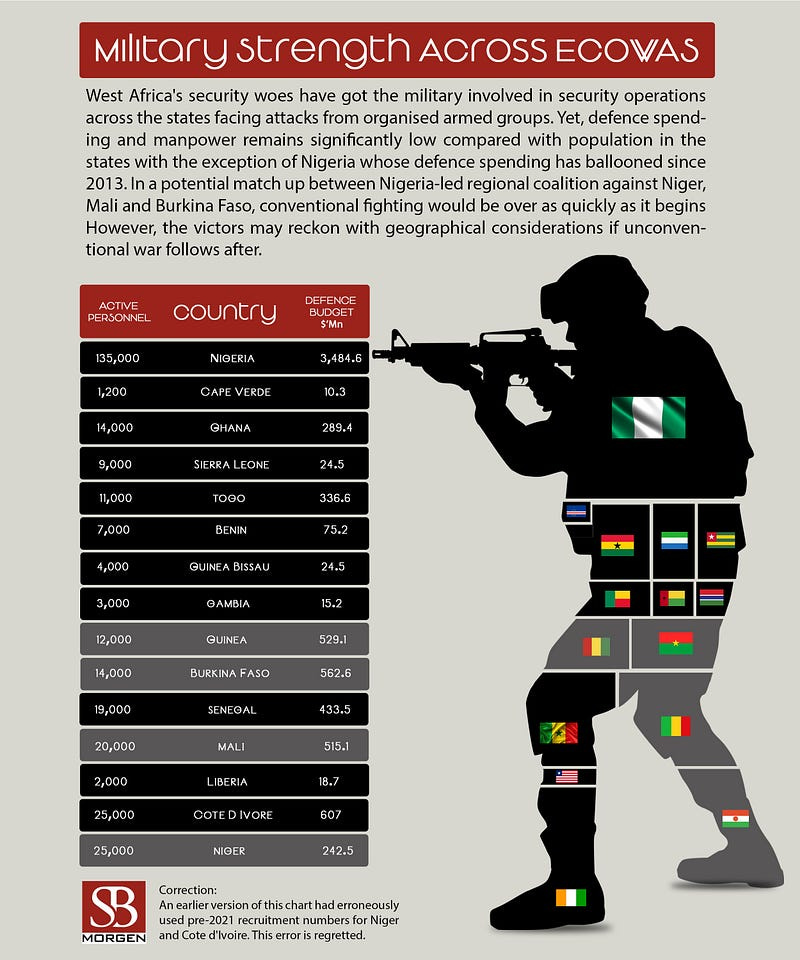
The refusal to announce the date of the planned military intervention is tailored towards reducing pressure on the contingent led by former Nigerian head of state Abdusalami Abubakar in their negotiations with the Niger junta. Also, it could be a move to deny the Nigerien military and its “allies’’ the option of a successful defence in the event of an attack. A major, often overlooked, reason why the standby force is yet to be deployed is not necessarily the mediation process but also the significant domestic opposition and political complexities, particularly within Nigeria. This week, a former Governor of Kaduna State in Nigeria, Nasir El-Rufai, said that an invasion of Niger Republic would be regarded as an attack on Northern Nigeria. Mr El-Rufai’s statement reflects the opinions of many in the core Northern regions, particularly in the states neighbouring Niger. Furthermore, some sections of the North portray the planned action against Niger as a religious war against Muslims spearheaded by the current Chief of Defence staff. A report broadcast on Arewa24, a Northern Nigeria-focused media organisation, pointed out that the new Chief of Defence Staff, General Chris Musa, is a Christian but sidestepped the fact that he is a Christian from Kaduna, which is in Northern Nigeria. Such narratives have tended to overshadow more critical concerns, notably a looming refugee crisis. This crisis could intensify due to military action, affecting not only the 300,000 Nigerian refugees in Niger but potentially involving others inadvertently caught in the conflict. As the confrontation between ECOWAS and Niger approaches, various actors have been trying to leverage the situation to their advantage, strategically positioning themselves and seeking personal gains. For example, while Mr El-Rufai adopted a firm stance through Northern advocacy, which might have been influenced by personal grievances over missing out on a ministerial position and an attempt to establish himself in the Northern elite caucus, miles away, the Algerians are capitalising on the moment to gain an upper hand over their former colonisers. Algeria and France have long been engaged in a post-colonial verbal conflict, particularly concerning French actions during the Algerian War of Independence in the 1950s. Regardless of our perspective on the recent developments concerning Niger, it’s evident that history and geopolitics are persistent forces that can lead to disastrous and far-reaching consequences if disregarded. ECOWAS would do well to consider alternatives to a military intervention in Niger. A military intervention would be a brash escalation of the situation and could lead to a long-drawn-out guerrilla warfare destabilising the region. It would also put neighbouring ECOWAS countries in the position of haughty foreign meddlers. Instead, a diplomatic approach that includes economic sanctions, a cold shoulder and increased pressure on the coup leaders to step down would be better. ECOWAS could also work with other international organisations to support a peaceful resolution to the crisis. A diplomatic approach would be more likely to succeed in restoring democracy in Niger without further destabilising the region. It would also be more in line with ECOWAS’s stated commitment to peaceful resolution of conflicts. Nigeria, in particular, is at the forefront of this agenda and should be mindful of how easy it would be for the Nigerien military to turn a blind eye (or lend a helping hand) to terrorists and bandits looking to attack Nigerian locations.