

Uber announced that it shut down its ride-hailing operations in Nigeria effective 2 September 2026, following a review of its business. The company informed drivers that they would no longer receive rider trip requests through the Uber app from that date. Uber described the decision as difficult and thanked drivers for their contributions to its operations in Nigeria over the years. The company said its platform had played an important role in connecting riders with independent drivers and supporting urban transportation. It did not provide details on the reasons for the shutdown. Uber’s Help Centre will remain available to drivers until 24 September to address questions about the closure.
Uber stopped taking rider requests in Nigeria from 2 September 2026, ending 12 years of operations in the country. Uganda is affected by the same decision. The company described it as a difficult call after reviewing business priorities, thanked drivers, and kept its help centre open until 24 September. It offered no specific explanation. It did not need to. The timing said enough: the Nigeria shutdown came roughly a day before Uber launched autonomous rides in London with UK self-driving firm Wayve, its second live autonomous market in Europe after Zagreb. The company’s capital is moving in a clear direction, and Nigeria is not in its plans.
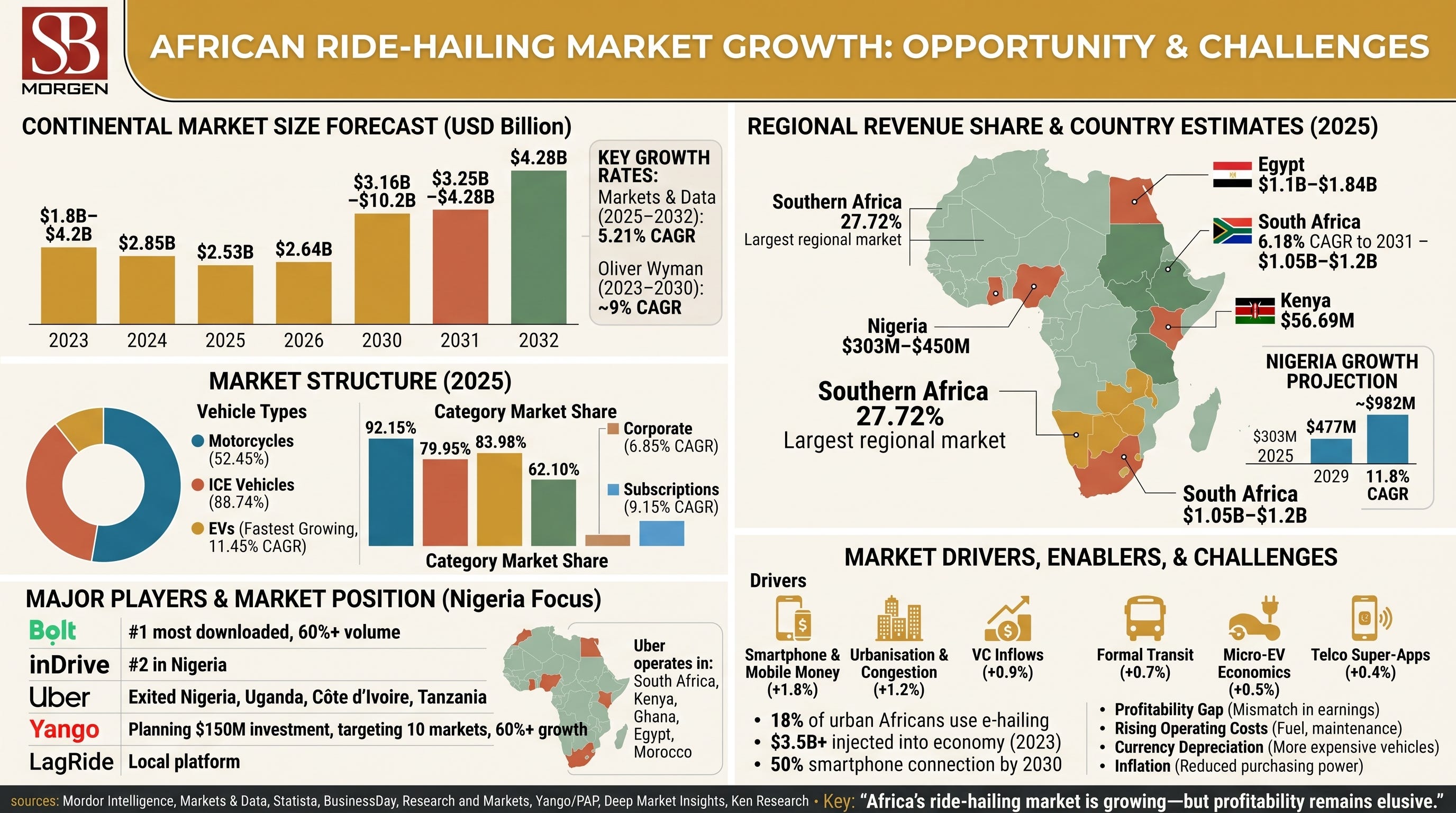
This is not an isolated decision. Nigeria is not even Uber’s first African exit in the current cycle. The company left Côte d’Ivoire in 2025 and shut down in Tanzania on 30 January 2026, citing fare controls and commission caps that squeezed margins to unprofitability. By that point Uber had roughly 1,500 active drivers in Tanzania against Bolt’s 30,000, illustrating how thoroughly the competitive ground had shifted before the formal exit. Uber now operates on the continent only in South Africa, Kenya, Ghana, Egypt and Morocco. The retreat from four African markets in roughly a year, alongside CEO Dara Khosrowshahi cutting 3,300 jobs globally to fund autonomous vehicles and robotaxis, is a coherent strategic pivot.
Nigeria shares the pressure points that ended the Tanzania business. Labour unrest has been a running problem: the Amalgamated Union of App-Based Transport Workers of Nigeria has held repeated strikes since at least 2016, demanding fare increases of as much as 200 percent, commission cuts and an end to arbitrary driver deactivations. A further Lagos strike was reported as recently as March 2026.
The regulatory environment, however, is where the story becomes more complicated. Lagos State tightened oversight of ride-hailing platforms, mandating real-time data sharing via direct API integration and threatening sanctions for non-compliance. In isolation, those requirements are defensible as consumer and safety measures. They read less neutrally alongside the Lagos State Government’s own stake in LagRide, the state-backed ride-hailing platform that has operated since 2022. Allegations that the state used its regulatory and enforcement machinery to tilt the playing field in LagRide’s favour, through selective enforcement, vehicle impoundments and compliance pressure applied unevenly across competitors, were never conclusively resolved. But the pattern was visible enough that operators and observers noted it, and it formed part of the backdrop against which Uber was making its calculations about the market’s long-term viability.
That dynamic points to a risk that runs well beyond ride-hailing. When government is simultaneously a regulator and a market participant, the line between legitimate oversight and competitive interference becomes difficult to draw, and the difficulty is not accidental. Private capital operating in that environment faces a problem that has nothing to do with market fundamentals: the rules can shift not because the policy has changed but because the state’s commercial interests have. That is a different kind of risk from currency volatility or consumer price sensitivity. It is harder to model, harder to hedge and harder to raise with a government that has every incentive to deny it exists. For Uber’s global headquarters, trying to justify continued investment in a market where a government competitor may be shaping the regulatory agenda is a conversation that ends quickly.
The macro environment compounded the structural problem. Naira volatility since the 2023/24 float made dollar-denominated cost structures increasingly difficult to defend. Driver payouts and technology maintenance are effectively priced in dollars while revenue is earned in naira. The 2023 fuel subsidy removal squeezed driver margins, pushing operators off-platform or toward competitors offering more direct control over earnings. InDrive’s bargain-a-fare model, which formalised what Nigerian riders already did informally with taxis and motorcycle taxis, fit local negotiating habits in a way Uber’s fixed surge-based pricing never quite did. Competitive position, currency drag, driver retention costs, and a global restructuring demanding capital reallocation each contributed. Together they made the outcome close to inevitable.
Africa’s ride-hailing market is projected to reach $3.25 billion by 2031. Turning that growth into profit remains a different problem from generating revenue, and Uber decided it was no longer its problem to solve in Nigeria. The harder question the LagRide controversy leaves behind is whether the next company looking at the Nigerian market will weigh the regulatory environment differently, or simply price in the risk of a government that competes with the businesses it regulates and decides the maths does not work. InDrive called Uber’s exit a surprise. The surprise is not that Uber left. It is that it stayed twelve years before concluding what the LagRide episode made explicit: in Nigeria, regulatory risk and commercial risk are sometimes the same risk.