
Under siege
Gunmen kidnapped at least 15 students from a school in Sokoto State in a dawn raid, days after some 300 students were abducted in Kaduna…

Gunmen kidnapped at least 15 students from a school in Sokoto State in a dawn raid, days after some 300 students were abducted in Kaduna State. In Chikun Local Government Area of Kaduna State, terrorists attacked a public primary school, abducting over 200 pupils and teachers. Residents said the gunmen invaded the school immediately after the morning assembly. In Borno State, Boko Haram abducted about 50 to 300 displaced women who lived in a camp in Gamboru Ngala. This comes as Borno’s government reports that 95% of Boko Haram fighters are dead or have surrendered.
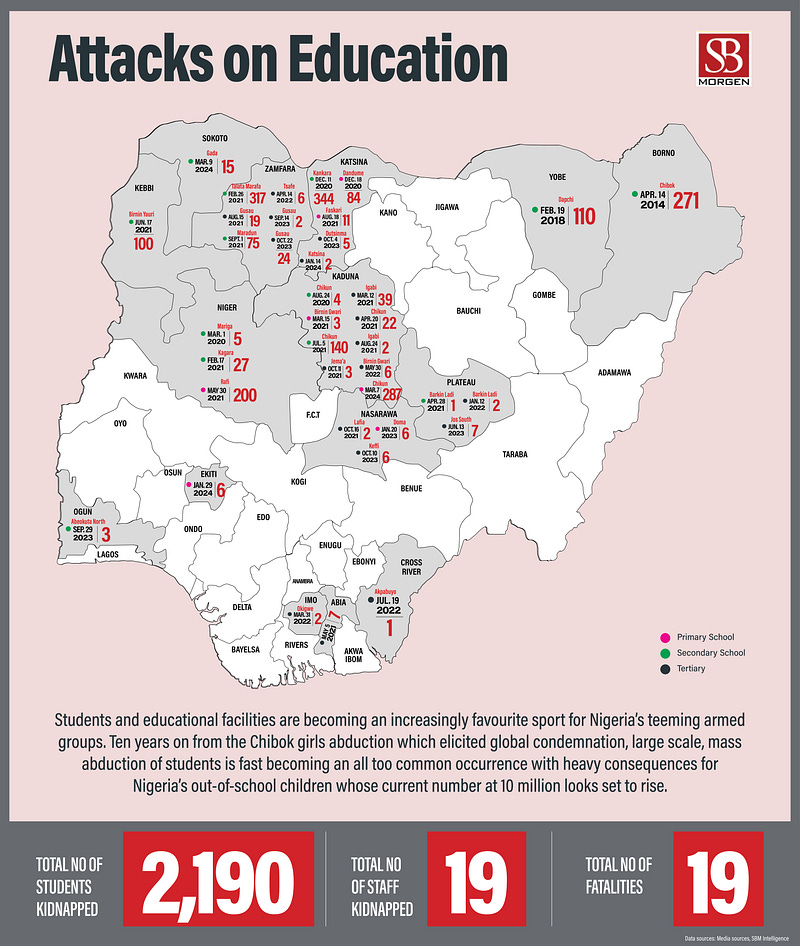
According to media reports compiled by The National Security Tracker (NST) and the Armed Conflict Location & Event Data Project (ACLED), there were an estimated 4,243 kidnappings reported in Nigeria in 2023 and by March 2024, Nigeria has had almost a thousand people kidnapped in Northern Nigeria alone as terrorist groups have gone on a spree of industrial scale kidnapping with some demanding ransoms as high as ₦40 trillion ($25 billion, 14/2/2023). Mass kidnappings, especially of women and children, are heinous acts that require a dehumanised mindset to be carried out. Poverty, suffering and lack of opportunity in the North and Sahel region, combined with religious extremism, create an environment conducive to dehumanisation and large-scale kidnappings and killings absent in a sane society. The extent to which large spaces remain ungoverned and the absence of consequences from security agencies and the justice system has made it easier for these dastardly elements to obey their inhuman impulses. Groups like Boko Haram also use kidnappings to fund their terrorist activities and stir fear in people’s hearts; and while ransom payment is said to be discouraged because it motivates criminals, it is difficult to expect people to leave their loved ones to be killed instead of paying for their release. The 2014 Chibok schoolgirls kidnapping was a watershed moment in the history of terrorism in Nigeria. For the first time, a terrorist group deliberately targeted a group of vulnerable civilians — young schoolgirls — to instil fear and achieve its political goals. This attack signalled a new level of brutality that had not been seen before and established Boko Haram as a force to be reckoned with. Perhaps the only other jihadist group which has adopted similar tactics is the Islamic State. It is also very likely that its Nigerian franchise, the Islamic State West Africa Province (ISWAP), may very well have had a hand in the abduction of the students in the Northwest, a region where it has gradually expanded since 2019. Although the group may be fighting a protracted civil war in the Northeast, the abduction of the female IDPs was most likely carried out by its enemy, the JAS faction. ISWAP, with established territories under its control, has less incentive for mass abductions compared to JAS, which relies on raids for survival. However, in the Northwest, both factions have no problems collaborating with bandit kingpins for reasons ranging from ransom value to the release of jailed jihadist fighters, as seen in the attack on the Abuja-Kaduna train two years ago. These unfortunate occurrences highlight the stark reality that Nigeria has hardly learnt from its problems. 2024 marks the 10-year anniversary of such an attack on educational facilities. Ten years have passed, and approximately 98 Chibok students remain missing. Multiple armed groups are now using the same modus operandi with alarming success, resulting in thousands of individuals being kidnapped across the Borno-Yobe area and the two other regions that comprise Northern Nigeria. For the 20 million out-of-school kids, this is another blow to the prospect of improving early childhood education enrollment in Nigeria. The government’s inconsistent policies may lead to further setbacks, potentially burying any hope of improvement.