
US accidentally sends protected migrants to wrong continent
Trump administration secretly deported nine people to Cameroon, despite US court protections, though none were Cameroonian nationals.

The administration of Donald Trump secretly deported nine individuals to Cameroon despite several having U.S. court protections against removal, according to a report by The New York Times. The newspaper said the migrants were flown on 14 January from Alexandria aboard a Department of Homeland Security aircraft. Some reportedly learned of their destination only after being restrained in handcuffs and chains, citing government documents and attorneys. None of the deportees was a Cameroonian national, and no public agreement has been announced indicating that Cameroon consented to accept third-country deportees.
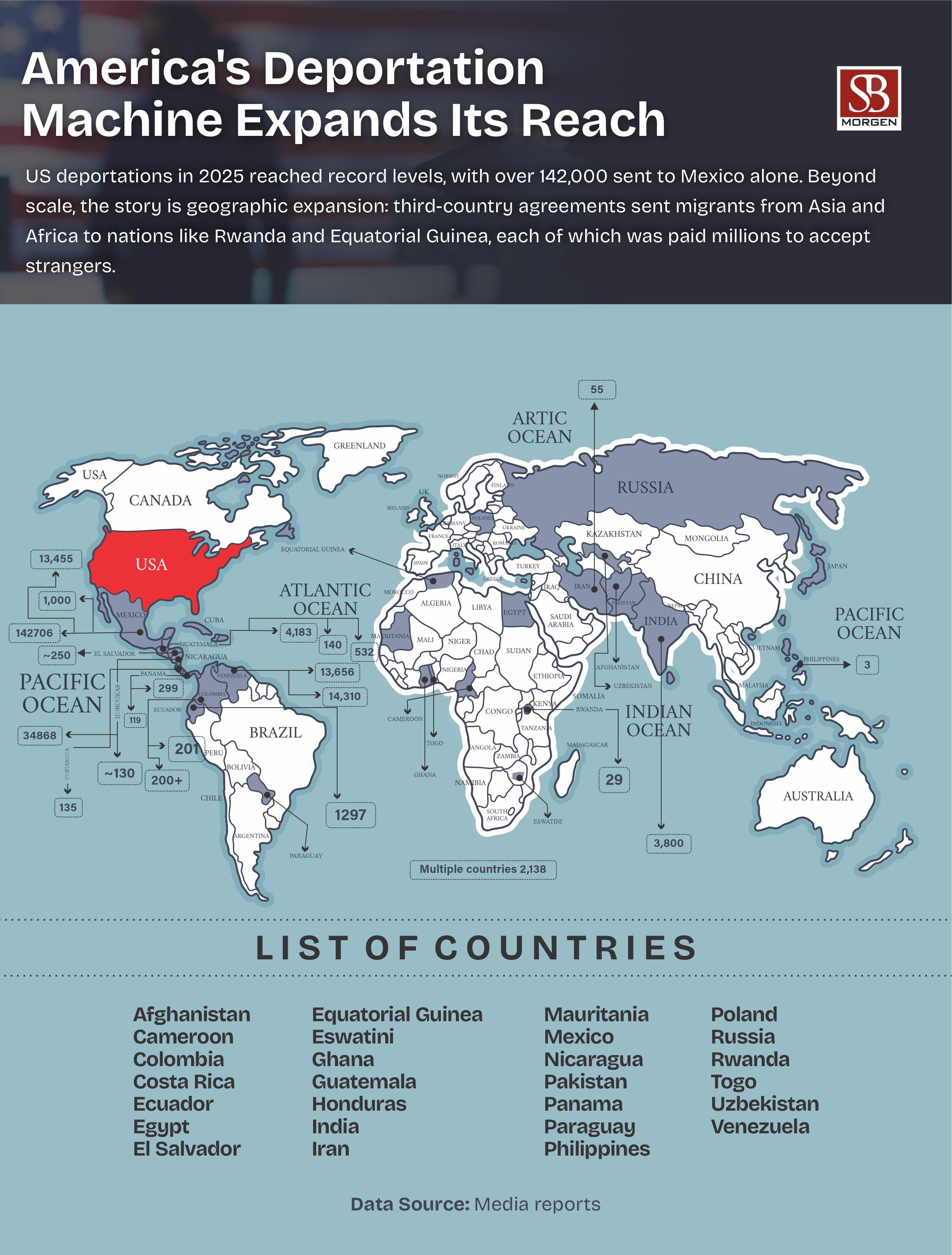
This forms part of the Trump administration’s aggressive push to bypass court protections during mass removals in the second term. Officials flew a group of nine non-Cameroonian migrants from Alexandria, Louisiana, to Yaoundé on a Homeland Security aircraft, with several reportedly restrained and only informed of their destination mid-flight. According to court filings and media investigations, most of those removed held withholding of removal orders or similar judicial protections due to persecution risks in their home countries across Africa and Latin America.
At the centre of this episode is the expanding use of “third-country” transfers. Rather than deporting individuals directly to the states from which U.S. courts have barred their removal, authorities are transferring them to a willing intermediary country, in this case Cameroon, which may then handle onward return. Formally, this allows U.S. officials to argue that they are complying with domestic court orders. Substantively, it creates a grey zone in which judges’ practical protection is diluted.
This is not an isolated tactic. During both Trump administrations, federal courts repeatedly blocked fast-track removal policies, mandatory detention rules, and attempts to revoke Temporary Protected Status. By early 2026, more than 300 judicial rulings had challenged aspects of immigration enforcement. In response, the executive branch increasingly leaned on appeals, narrow legal reinterpretations, and operational workarounds. The Supreme Court has occasionally sided with the administration, including in decisions that allowed the revocation of protections for tens of thousands of migrants in early 2026. But in other instances, enforcement actions have moved faster than judicial review, leaving individuals to seek relief through emergency habeas petitions after removal.
The Cameroon transfers appear to reflect a more systemic evolution. Reports suggest quiet arrangements with multiple countries, including Eswatini and Rwanda, under which deportees are received in state-run facilities. In the 14 January case, eight of the nine individuals reportedly held active U.S. court protections, including asylum-related stays tied to fears of LGBTQ+ persecution or forced conscription. A second flight in mid-February signals that this is not an administrative error but an operational model.
From a legal standpoint, the risk exposure is significant. Third-country removals without transparent bilateral agreements and clear due process protocols are vulnerable to constitutional challenge. If courts determine that the executive is indirectly achieving what it is barred from doing directly, the practice could face injunctions. For individuals involved in the logistics chain, including contractors and foreign state agencies, the human rights liability is non-trivial, particularly if deportees are subsequently coerced into returning to unsafe environments.
For Cameroon, the calculus is geopolitical rather than legal. Quiet cooperation may be tied to diplomatic leverage, development support, or broader security alignment with Washington. African states facing fiscal pressure may view such arrangements as opportunities for transactions. However, accepting third-country nationals with complex asylum claims carries reputational and governance risks, especially if detention conditions or onward removals trigger international scrutiny.
At a systemic level, this signals a shift in U.S. asylum policy architecture. Instead of contesting court rulings directly, the administration is redesigning the enforcement landscape. Protection is no longer solely a question of whether someone can be sent home, but where they can be placed in transit. The danger is that asylum norms become functionally hollowed out, preserved in legal text but undermined in operational practice.