
Value-added talk
Nigeria’s Finance, Budget and National Planning Minister, Zainab Ahmed, has urged the incoming administration to increase the Value Added…

Nigeria’s Finance, Budget and National Planning Minister, Zainab Ahmed, has urged the incoming administration to increase the Value Added Tax (VAT) from the current 7.5 percent to 10 percent, saying this would stimulate the country’s economic growth. She said the government had used the finance bills to block leakages, and strengthen the Federal Inland Revenue Service (FIRS) and the Nigeria Customs Service. The minister also disclosed that the federal government would remove the controversial petrol subsidy before the end of President Muhammadu Buhari’s tenure, attributing the delay to the 2023 general elections and the forthcoming national population census.
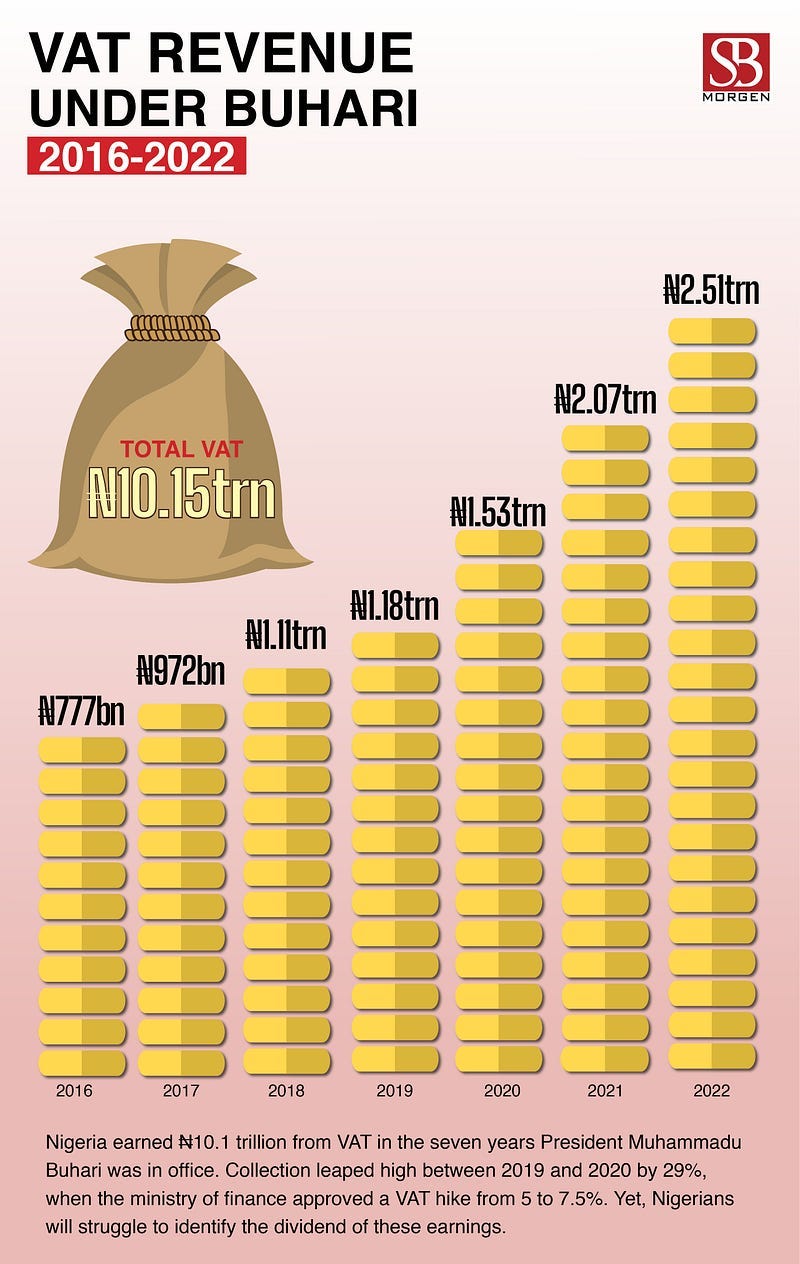
In one of the bits of political theatre that Nigeria continues to spit out in spades, the country’s finance minister is asking her successor to tighten the cost item she turbocharged on the Nigerian economy while advocating for the kind of revenue leakage plugs that her ministry has been advocating for in finance bills since 2020 but hasn’t driven through. There are enough short and mid-term cost-swelling actions that Mr Tinubu’s financial team must take up once they get into office, which would make life unbearable for Nigerians in the short term but benefit the economy. Ms Ahmed has already set the ball rolling on one of those necessary inflation drivers — the subsidy. By the budget assumptions her team prepared and the Ninth Assembly approved, fuel subsidies should be gone by June, almost doubling what Nigerians pay now for petrol. It is unclear if that will happen. The next is electricity subsidy. In the first quarter of 2022, the Nigeria Electricity Regulatory Commission (NERC) said ₦35.2 billion ($47.5 million) was paid to reduce the deficit in the electricity value chain. The government has said it would stop electricity subsidy payments, but it has reneged on that vow. If Nigerians are to see a progressive increase in power supply, then the government would have to find ways to work with unions and other stakeholders to increase distribution companies’ cost and billing efficiency. That way, the companies can raise more money for operating expenses and improve their service delivery. According to the Nigerian Energy Support Programme (NESP)’s 2023 report, the shortfall in electricity tariff reached ₦2.5 trillion in 2022, and it projects ₦600 billion more to be added to that in 2023. This deficit has to be chipped at by Nigerians, which would add to the inflationary pile. On top of these, the new CBN governor would need to remove most, if not all, of the 44 blacklisted items for forex. Whoever that person will be would have to ease the levers on forex inflows and outflows to boost confidence in that sector. That again, in the meantime, would temporarily swell inflation. In other words, increasing VAT to 10% does not rank that high on the priority list. The government should be using existing resources to facilitate trade liberalisation in Nigeria, which is heavily concentrated in Lagos and is set for even more concentration when the Lekki Free Trade Zone starts full operation. That would serve as a major signal to investors that this is a sensible place to do business. Data on capital imports for Q3 2022 is not yet available, but Q2 2022 data showed a 2.4% decrease in capital importation from Q1. Over the same period, foreign portfolio investment plunged by 21% and direct investment by 5%. Put another way, Ms Ahmed and her boss, the President, are leaving behind an asphyxiated economy. With a VAT rate of 5%, Nigeria achieved its highest tax-to-GDP ratio in 2011 at 9.6%, according to the Organisation of Economic Cooperation and Development (OECD.) The lowest was 5.3% in 2016. Debatable as it may sound, the most revolutionary contribution the finance ministry achieved in the last eight years is the tax amnesty scheme, VAIDS, implemented by the Federal Inland Revenue Service (FIRS) in 2017, and that was implemented by Ms Ahmed’s predecessor, Kemi Adeosun. Laudable as VAIDS was, it added less than 50 basis points to Nigeria’s low tax to GDP rating despite the then FIRS boss, Babatunde Fowler, saying in 2018 that five million more people were added to the tax net, bringing the overall number of taxpayers to over 19 million. As Ms Ahmed bows out of office, she leaves a tax-to-GDP ratio of 5.5%. That figure is a decline from the 6% achieved in 2019, 18 months after VAIDS concluded in June 2018. In that year, Nigeria’s tax-to-GDP ratio was 6.3%. Although the Buhari administration pushed hard on levying Nigerians for income, it could not maintain the momentum it gained in 2017. The next two OECD reports will complete the frame of Ms Ahmed’s revenue generation prowess. While her call to increase the VAT rate — particularly when compared to the Africa average — may be in order, we disagree with her reasoning concerning the outcome that an increase in the VAT rate will drive economic growth. It is likelier in fact, to increase transaction costs and reduce overall trade volumes while boosting government revenues — a very short-term gain. Rather than scaring away potential investors and further depressing business in Nigeria, the government should address issues that limit its revenue-generating capabilities and encourage doing business in Nigeria. The work of widening the tax net, stimulating economic growth, and generating more employment is more important than merely increasing tax rates. When the majority of young people who should form the bulk of the tax-paying net in the country are without employment, tax revenues suffer. An increase in tax revenue is an incidental to economic growth and not the driver. Therefore, the government should be focused on economic growth and employment; the tax revenues will follow. Nigerian businesses are already operating under the worst conditions; they don’t need slack ministers to make things worse.