
Victory lap
Nigeria's Customs saw revenue collection reach of ₦6.1 trillion in 2024, surpassing its target by 20.2% and representing a 90.4% increase from 2023.

The Nigeria Customs Service (NCS) has achieved a record-breaking revenue collection of ₦6.1 trillion ($3.65 billion) in 2024, surpassing its target of ₦5.08 trillion by 20.2%. This represents a 90.4% increase from the ₦3.21 trillion collected in 2023. The revenue was generated from three main categories: Federation account collections (₦3.66 trillion), Non-federation account levies (₦816.90 billion), and Value Added Tax (VAT) on imports (₦1.63 trillion). Despite granting concessions worth ₦1.68 trillion, the NCS achieved this performance, attributing it to its alignment with government policies and the dedication of its staff.
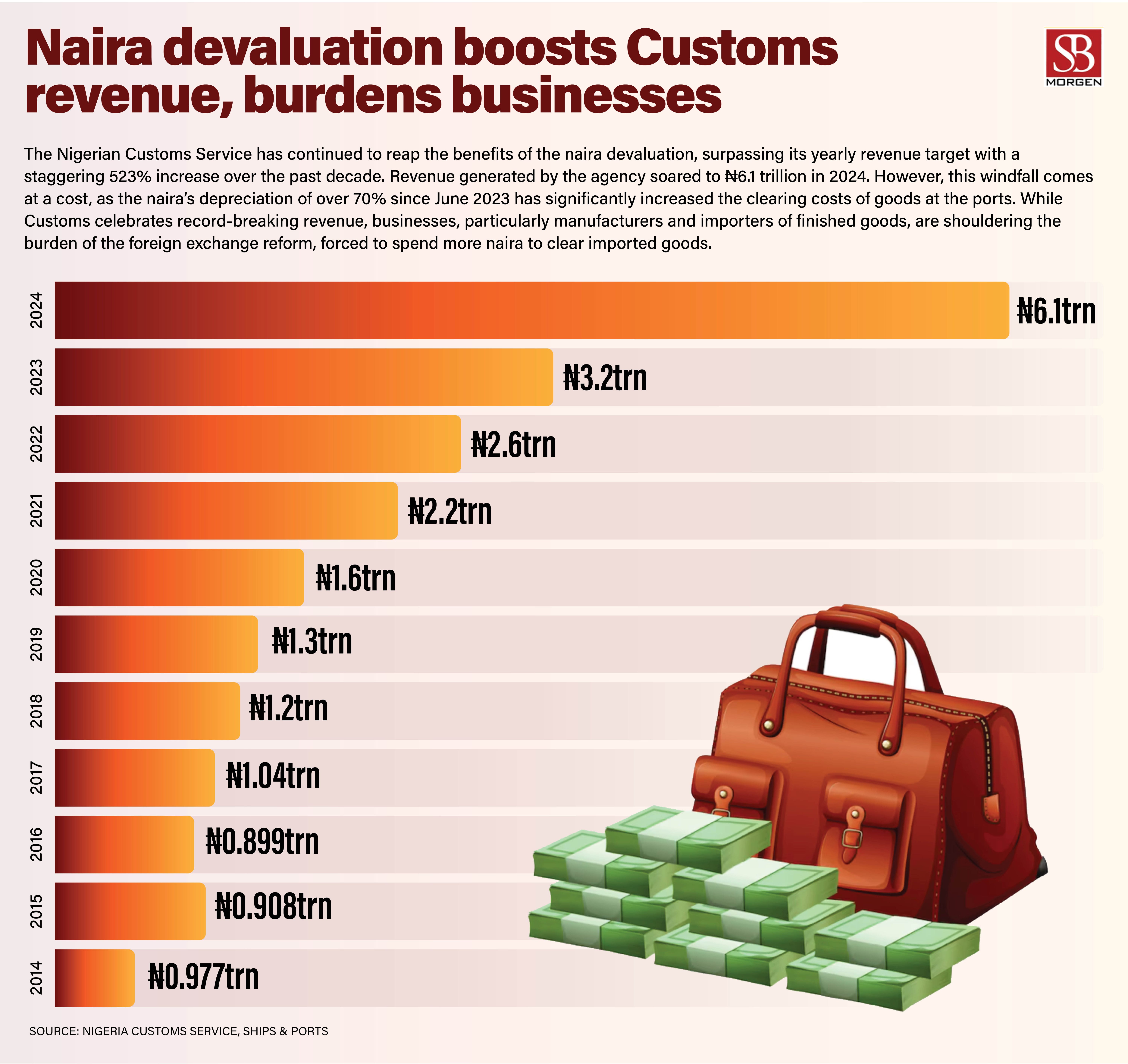
The Nigeria Customs Service has made significant progress since 2017, when it crossed the ₦1 trillion revenue mark. It has proposed a revenue target of ₦6.58 trillion for 2025, and federal legislators think this should be increased to ₦12 trillion and another ₦25 trillion for the Federal Inland Revenue Service. These amounts, when combined, exceed the government’s revenue target for the 2025 budget!
However, it is important to unpack the figures to understand how the Customs works its magic. The factors driving annual record-breaking are largely currency devaluation, so in real terms, when right-sized using the exchange rate in the year of reporting, it will be evident that rather than growth, revenue has been largely stagnant or even in decline. Moreover, the 2024 numbers can be attributed mainly to lower concessions and higher imports. According to the Customs chief, concessions worth ₦1.6 trillion were given in 2024 compared to ₦3.95 trillion in 2023. Every concession is money left on the table, and a decline may signify that decision-makers at the agency are handling concession matters with increased scrutiny.
In 2024, Nigeria’s Customs processed imports worth ₦60 trillion compared to ₦27.7 trillion in 2023. The export numbers also increased significantly from ₦42.77 trillion in 2023 to ₦136.65 trillion in 2024. Although the value of the exports processed far outweighs that of imports, the number of transactions in each category paints a clearer picture. Customs processed 1.2 million import transactions weighing 15.35 billion kilograms compared to 38,199 export transactions weighing 12.35 billion kilograms. These figures explain the nature of imports and exports in Nigeria, where bulky raw materials are exported while processed goods that weigh significantly less than the raw materials are imported. The naira devaluation presents an opportunity to boost exports, but only resilient businesses can utilise this opportunity.
Additionally, the FG’s tax reform proposal to create the Nigeria Revenue Service and consequently strip the NCS and other government agencies of their revenue collection responsibilities has likely made the NCS to step up on enforcement and reduce revenue leakages to show the government that it is still capable of doing the job.
Therefore, the NCS numbers are not just figures; they tell an important story with recommendations on how to grow Nigeria's economy. On the other hand, while revenue generation is an important metric, it should be secondary for Customs. The agency’s primary role is to facilitate trade, and in this regard, it continues to fall short. It is imperative to realign the metrics used to measure the NCS’s success to prioritise its function as a trade enabler. This realignment will help ensure that the NCS contributes effectively to the country's broader economic development goals.