
Violent surge in Zamfara
A surge of bandit violence in Nigeria's Zamfara state has killed eight security personnel and seen 73 villagers abducted in separate attacks.

Zamfara State has witnessed another surge in bandit violence, with at least eight security operatives killed and 73 villagers abducted in separate attacks. On Thursday, armed bandits ambushed a patrol along the Gusau–Funtua road in Tsafe Local Government Area, killing five police officers and three community protection guards. Governor Dauda Lawal condemned the killings as a tragic loss and renewed calls for urgent action to end insecurity. In a separate overnight raid, gunmen attacked Buzugu and Rayau villages in Bukkuyum LGA, abducting 73 residents and fleeing with them to an unknown location. Security forces and vigilantes have launched rescue operations. The attacks come amid a spate of recent kidnappings and killings across Zamfara, including the abduction of local officials and worshippers. The escalating violence highlights the persistent security crisis in northwestern Nigeria, where armed groups continue to operate with impunity despite ongoing military deployments.
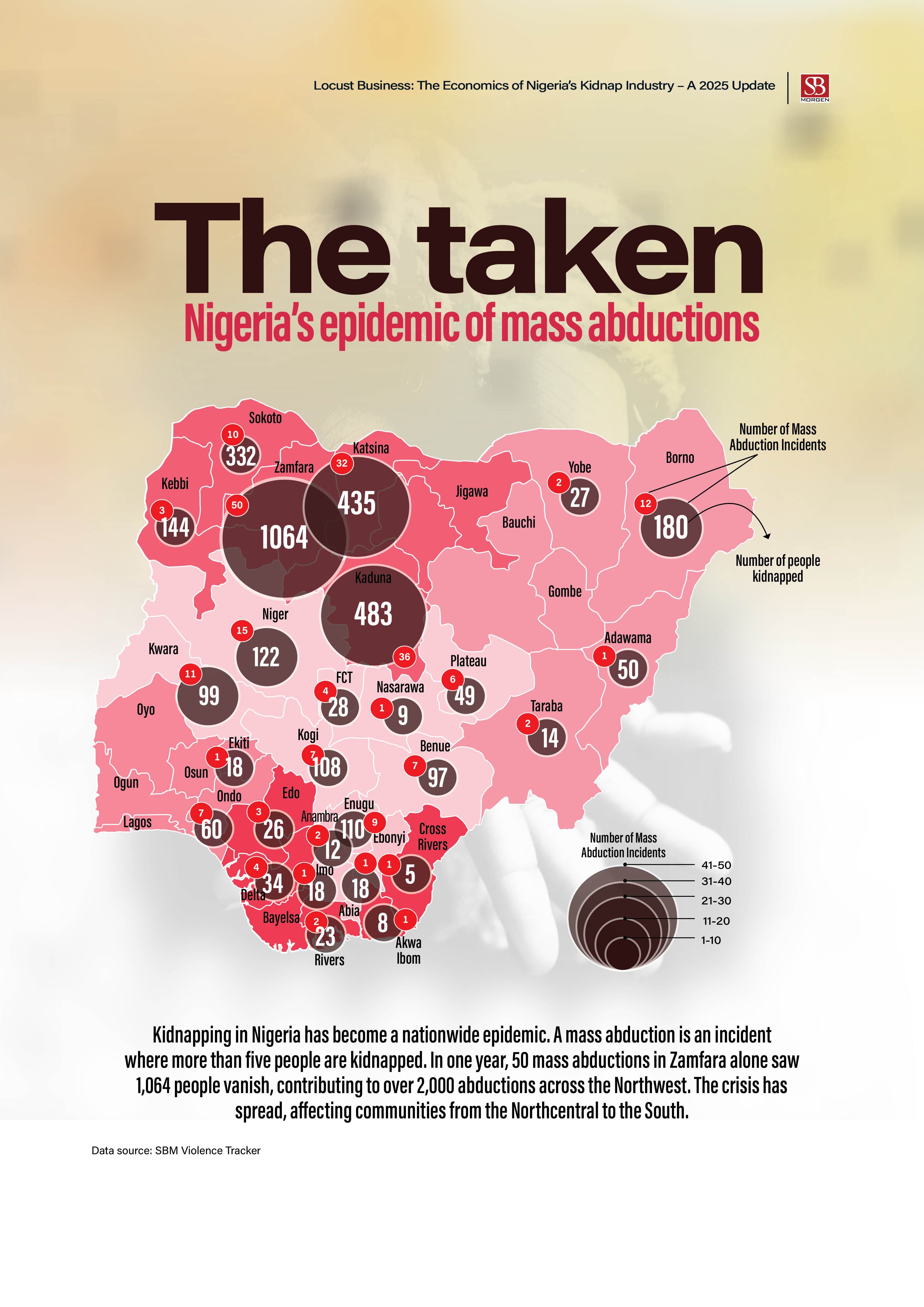
The surge in banditry across Zamfara and much of the Northwest reflects how Nigeria’s security crisis has evolved from isolated rural violence into a complex, multi-layered insurgency that increasingly targets the state itself. What began as localised disputes between armed groups and farming communities has now become a broader conflict in which state security forces are direct combatants.
Zamfara’s position as a major epicentre of this crisis is starkly illustrated by the data in SBM Intel’s latest report on kidnapping, which shows the state led in the total number of people kidnapped nationwide, with 1,203 residents abducted, accounting for 25.4% of the total. Furthermore, the state is a leader in mass abductions, incidents where more than five people are kidnapped, leading the count with 50 of the 231 incidents recorded.
The recent killing of five police officers and three community protection guards in the state underscores a dangerous escalation. Bandits who once avoided clashes with armed personnel are now emboldened, attacking patrols, raiding bases, and ambushing convoys. This shift is explained by two factors.
First, the proliferation of state-backed vigilante and hybrid security units has blurred the line between civilians and combatants. In states like Zamfara, where local authorities have established joint task forces, initial successes in reclaiming villages have made these groups prime targets for reprisal. The state’s adoption of a “whole-of-state approach” has involved regular security operations by the Zamfara Community Protection Guards, the military, and police working together. This effort explains why Zamfara accounts for both the highest number of kidnappers killed (23) and the highest number of security agents killed (7) in the period under review.
Second, intelligence from the region increasingly points to jihadist infiltration within some bandit networks, particularly in Zamfara’s western corridor. This ideological alignment has introduced new tactics, direct confrontations with the military and attempts to capture bases, reminiscent of early Boko Haram expansion patterns in the Northeast.
Beyond the immediate violence, these dynamics signal the erosion of the state’s monopoly of violence. As the conflict expands, the risk of wider destabilisation grows, not just within Zamfara but across neighbouring states. The situation in Plateau offers a cautionary parallel: long-standing communal disputes have become entry points for armed groups seeking territorial control and recruitment opportunities.
Nigeria’s heavy reliance on military deployments to suppress banditry has yielded only temporary relief. Kinetic operations clear territories but fail to address the deeper governance and economic vacuums that sustain armed violence. Restoring stability requires an integrated approach; one that strengthens local governance, rebuilds trust in law enforcement, and disrupts the financial and ideological networks sustaining these groups. Without such strategic recalibration, Zamfara’s tragedy will remain a recurring national headline, not an isolated event.