
War declared on everything but boredom
President Tinubu declares a security emergency, ordering military expansion, police redeployment, and international talks to tackle armed groups nationwide.

President Bola Tinubu has launched sweeping actions to stabilise Nigeria’s worsening security situation. In a nationwide address, he declared a security emergency and ordered a major expansion of the armed forces, including the recruitment of 20,000 additional police officers and the redeployment of personnel from VIP protection to conflict zones. He also approved the deployment of trained forest guards by the Department of State Services and urged the National Assembly to accelerate work on state police. The presidency also intensified international engagement, naming a high-level delegation led by National Security Adviser Nuhu Ribadu for talks with the United States on security cooperation. The shake-up then reached the cabinet, with Defence Minister Mohammed Badaru resigning and former Chief of Defence Staff Christopher Musa nominated to replace him. To cap off a busy week, Tinubu then held a series of closed-door meetings with service chiefs and demanded more decisive action against armed groups across the country.
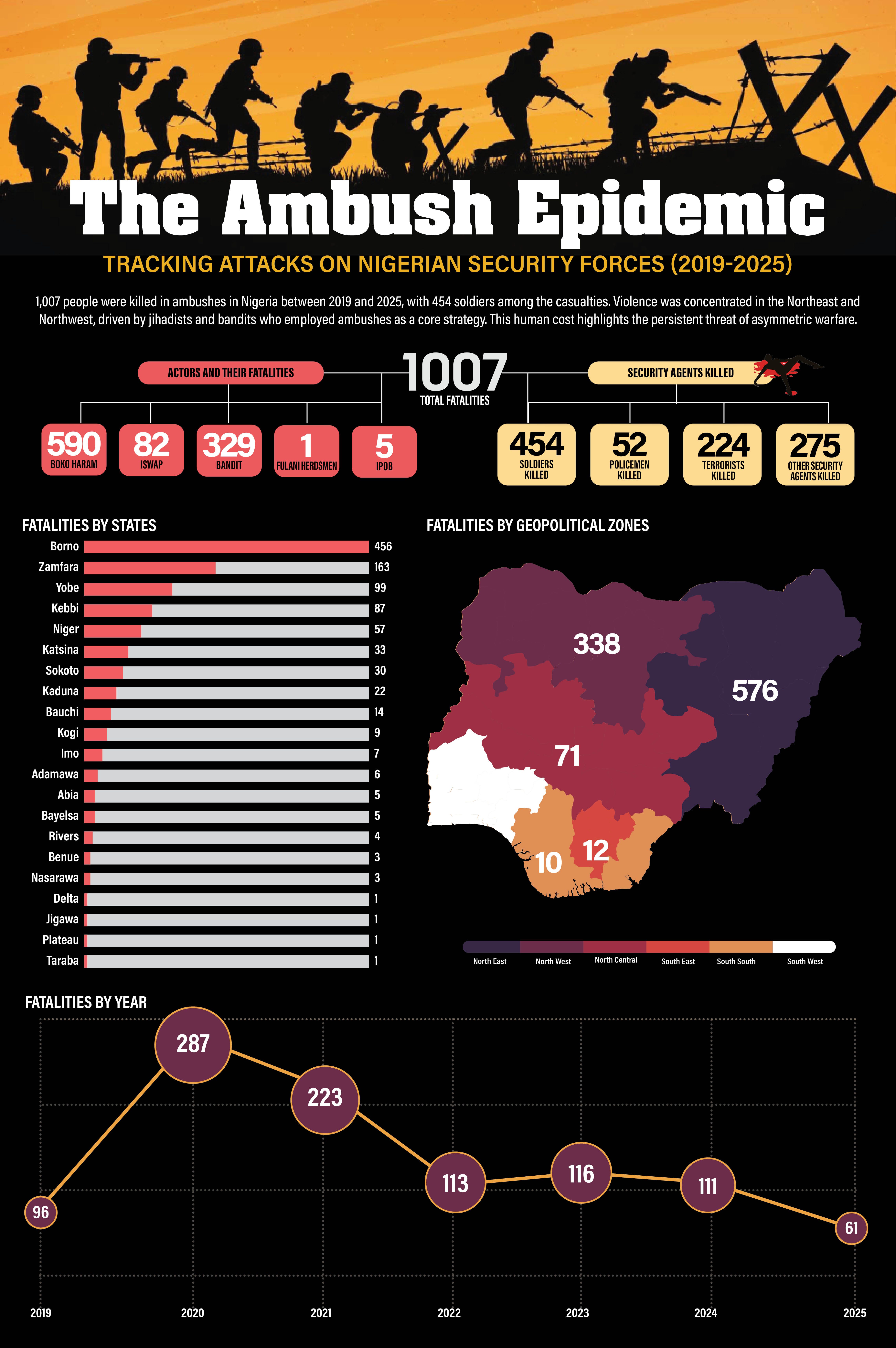
President Tinubu’s actions mark a long-overdue intervention in Nigeria’s worsening insecurity landscape. The declaration of a security emergency and the announcement of sweeping measures, including the recruitment of 20,000 additional police officers, the redeployment of personnel from VIP protection to conflict zones, and the deployment of trained forest guards by the Department of State Services, signal a reactive posture shaped as much by international and domestic scrutiny as by internal strategic foresight.
This renewed urgency did not emerge in a vacuum. It follows months of advocacy from stakeholders and a surge in external pressure after the United States redesignated Nigeria as a ‘country of particular concern’. That label, amplified by commentary from figures such as Donald Trump, drew global attention to Nigeria’s faltering security management and placed the administration on the defensive. However, the domestic instability cannot be divorced from the wider regional crisis in the Sahel, which now accounts for half of global terror deaths. In this volatile neighbourhood, weak state control allows armed groups space to recoup and recruit, creating a spillover effect that directly fuels Nigeria’s internal crisis.
Recent events underscore the depth of this challenge. High-profile attacks, including the kidnapping of students in northern states and the renewed strength of the Islamic State West Africa Province (ISWAP) in Borno, resulting in the death of a brigadier-general, raise serious questions about the capacity and cohesion of the armed forces. While the President’s announcement recognises the urgency of the situation, the measures themselves face deep structural obstacles. Expanding the police force, for instance, risks prioritising quantity over quality. Without sustained training, logistics and intelligence capabilities, and without addressing root causes such as sectarian tensions, resource competition and small-arms proliferation, new recruits will simply be overstretched in a system already weakened by corruption and chronic underfunding.
At the core of these challenges is the broken ‘trust thread’ between the state and its citizens. You cannot defeat an insurgency without the trust of the local population, yet poor welfare provisions and the psychological toll on service members erode the very morale required to build that confidence. Many personnel still fear that the state will not support their families if they are killed in action, a sentiment that undermines operational effectiveness.
Parallel to these operational challenges is the significant shift within the cabinet. The resignation of Defence Minister Mohammed Badaru is less a reflection of personal circumstances and more a symptom of a profound governance failure during a declared national security emergency. His replacement, former Chief of Defence Staff Christopher Musa, brings a different profile. As a genuine counter-insurgency specialist with experience leading Operation Hadin Kai and the Multinational Joint Task Force, Musa understands the battlefield. However, his nomination introduces a mixed dynamic of uncertainty and opportunity. Any transition at the top risks slowing coordination among key ministries—Defence, Interior, Finance and Justice—potentially causing a loss of momentum while the new minister navigates the civilian bureaucracy.
While Musa’s military background could help bridge the gap between the armed forces and civilian leadership, a skilled general alone cannot mend a shattered social contract or a reactive security architecture. His appointment acts as a tactical nod to the crisis rather than a strategic fix. Ultimately, Tinubu’s announcements project decisiveness, but without a fundamental, community-trusted overhaul that addresses both internal governance and regional threats, the administration is merely changing the driver of a broken vehicle. The coming months will test whether the government can match its rhetoric with the consistency and political courage needed to restore the state’s capacity.