
Where Nigerian families actually thrive
Kano tops Nigeria quality of life survey; Cross River languishes at bottom. Abuja ranks fourth, undermined by poor affordability.

Kano and Rivers lead the eight Nigerian states in quality of life for families, while Cross River is in crisis on every metric, with nearly nine in ten residents saying they want to leave. Two separate SBM Intelligence surveys, conducted across eight states between January and May 2026, form the basis of this analysis.
The Quality of Life Survey, completed in May, asked residents to rate twelve dimensions of family life, from income and safety to school quality and healthcare. The Power Survey, conducted in January, measured grid supply hours, satisfaction with electricity distribution companies (DISCOs), and residents’ outlook on power over the next two years. The power data serves as a proxy for infrastructure quality and economic confidence. In Nigeria, the quantity of electricity you receive is inseparable from your ability to live and work, and residents’ answers capture that reality directly.
The combined picture, drawn entirely from what people in each state told us, is striking. Kano, frequently overlooked in national quality-of-life conversations, tops the composite ranking. Its residents report the best perception of grid supply, the safest streets, the most affordable daily life, and the easiest access to childcare of all states surveyed. Rivers follows closely in second place, driven by strong family stability, the lowest frequency of disruption, and the best healthcare scores.
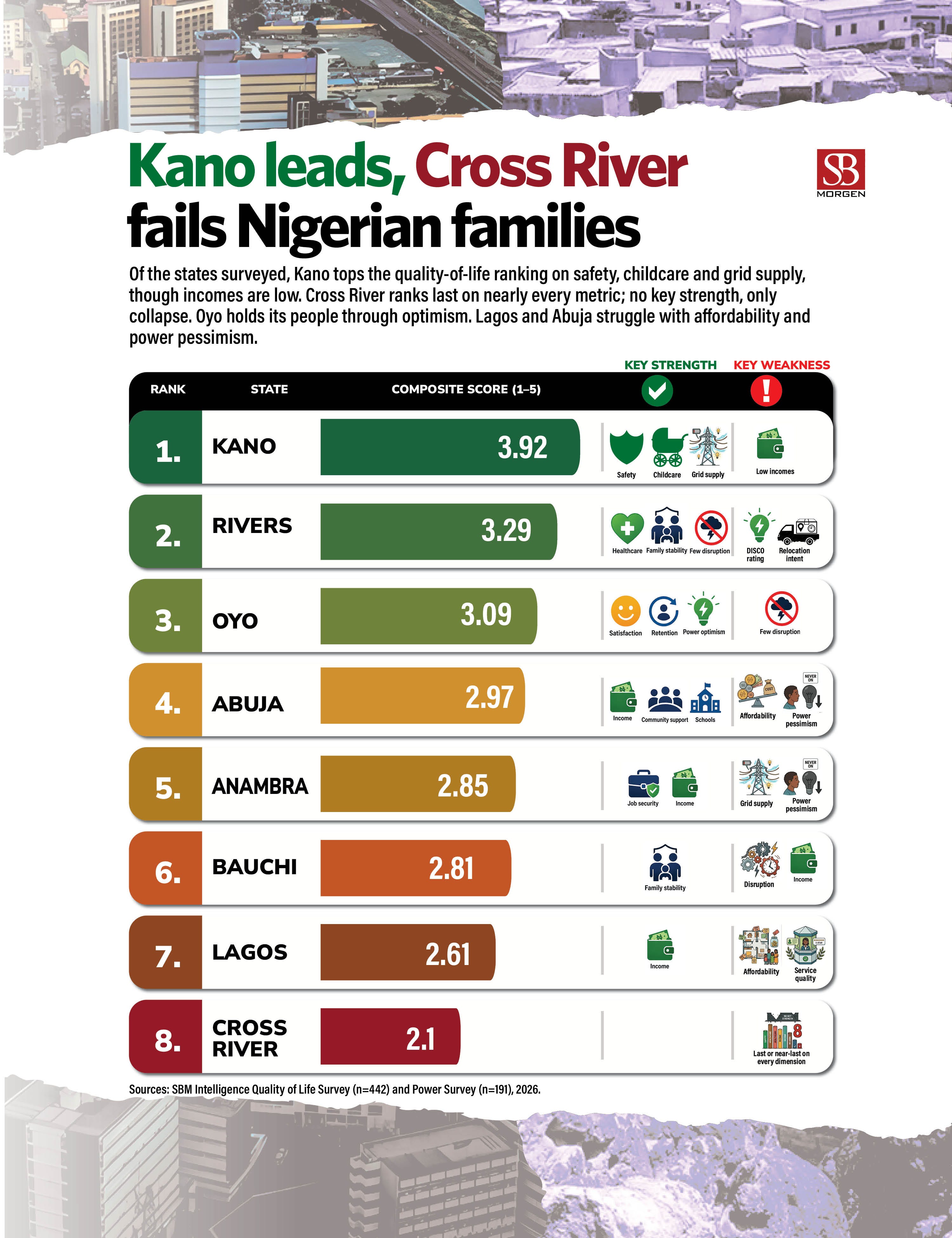
At the opposite end, Cross River scores last on eleven of fifteen dimensions. Abuja, the country’s aspirational city, ranks fourth. It performs well on income and support networks but is undercut by poor affordability and a strikingly pessimistic outlook on power.
The data closely mirrors wider national trends. Lagos’s housing crisis and soaring rents have made the city unaffordable for many families. Kano has taken aggressive steps to improve safety, deploying a 2,000‑strong neighbourhood watch and negotiating cross‑boundary intelligence sharing with three neighbouring states. Cross River’s collapse is no secret: two investigations found communities in the state with no electricity, passable roads, or functioning schools, while the state’s education and health commissioners have been accused of prioritising political loyalty over competence. Anambra’s power crisis is so severe that the state government seized control of electricity distribution from the national operator, issuing a licence to a new distributor in a bid to fix a system its own residents say is broken.
For the Nigerian parent deciding where to raise a child, the answer increasingly depends on what trade‑off they can afford, at least as their neighbours see it.
Download complete report (27 pages)