
Obi cries wolf
Peter Obi claims government pressure and intimidation could prevent him from contesting the 2027 election, saying he "might not even be alive."

Peter Obi, the Nigeria Democratic Congress’ presidential candidate for the 2027 election, has alleged that persistent government pressure and intimidation could prevent him from contesting, saying he “might not even be alive” by then. Obi claimed he faced daily harassment, including being denied privileges and having his car locked at an airport while others were left untouched. He also alleged that associates avoided greeting him publicly and supporters discouraged his attendance at family events. The Federal Government had not responded to the allegations at the time of reporting.
By the lofty standards of Nigerian political drama, this is pretty tame stuff. Peter Obi’s comments are a pastiche of everyday grievances: an airport parking fine that became a political persecution, friends who now decline to invite him to family events, and a vague sense that “every single thing I do for a living, this government is frustrating it.” For someone who can name the price of a bag of rice in Anambra’s major markets, this is a candidate who has traded granularity for grievance, and the shift is as revealing.
The Presidency’s response has been predictably brutal, dispatching its spokesman, Bayo Onanuga, to dismiss Mr Obi as a “pathological and serial liar.” The tone is notable for its personalisation. This is not a denial of policy substance but an attack on character, suggesting that the administration sees Obi not as a policy rival but as a credibility problem to be managed.
Doing his part, Aviation Minister Festus Keyamo weaponised the airport incident with characteristic flair, releasing CCTV footage to demonstrate that Obi’s car was clamped for a 30-minute parking violation, not political persecution. Mr Keyamo has demanded a public apology and imposed a ₦25,000 fine, effectively turning a parking dispute into a national spectacle.
The irony is that both sides are probably right: the government is probably not running a systematic operation to harass Obi, and Obi is almost certainly experiencing genuine frustration at a system that treats opposition figures with casual contempt. The question is how Nigerians will appraise this issue.
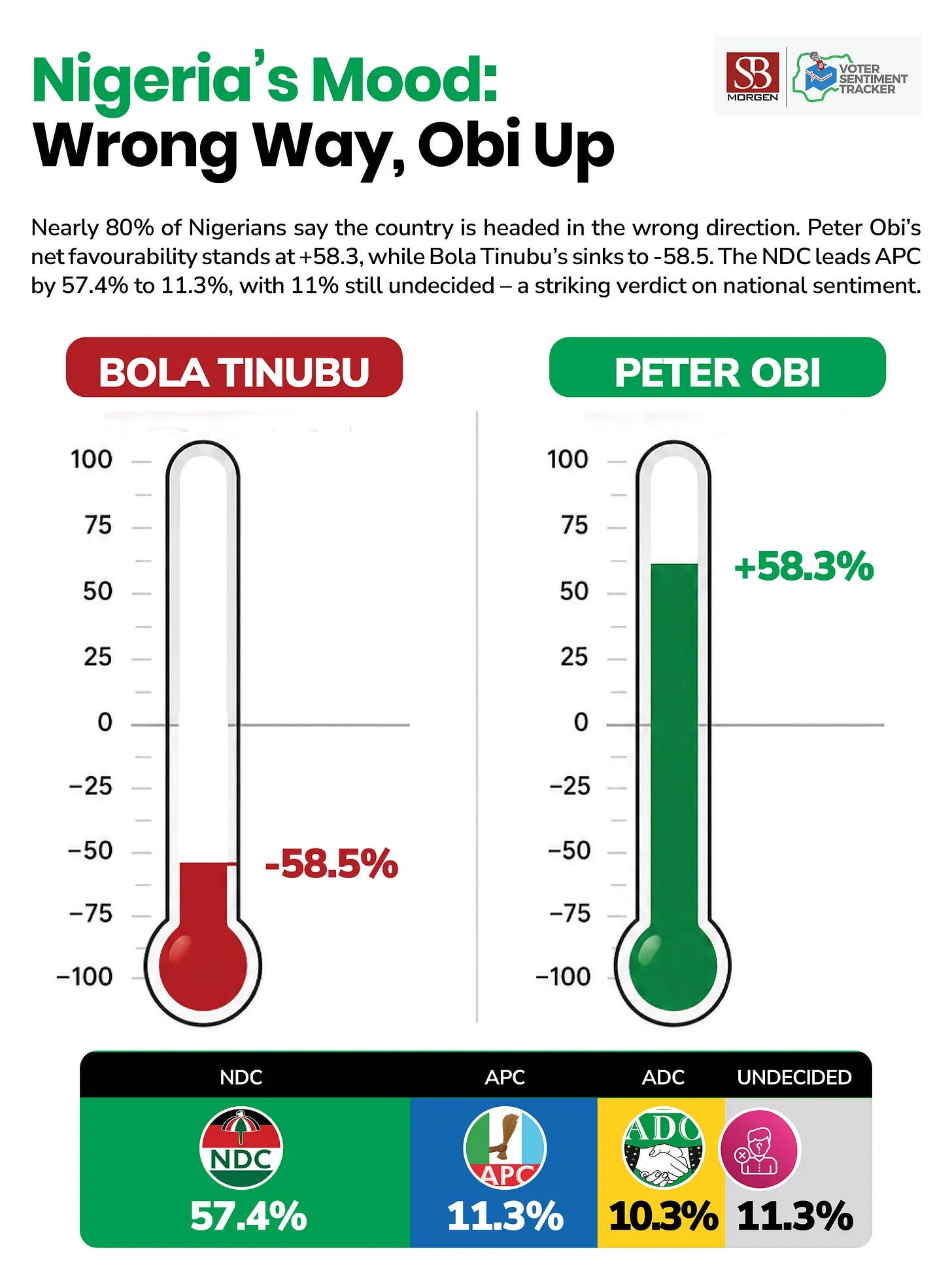
Enter the SBM Voter Sentiment Tracker, which provides the quantitative scaffolding for understanding why Obi’s claims land differently than they might have a year ago. Nearly 80% of Nigerians say the country is moving in the wrong direction, with dissatisfaction exceeding 88% in the Southeast, South-South, Northcentral, and Northwest. President Tinubu enters the 2027 race with a net favourability score of -58.5 nationally, the weakest of any candidate in the survey. Peter Obi, by contrast, records a net favourability of +58.3—the only candidate in positive territory, and he even leads in the Southwest, Mr Tinubu’s home base. These numbers explain why Obi’s allegations, however circumstantial, resonate with a public that has already concluded the government is failing them. When eight in 10 citizens believe the country is headed in the wrong direction, a candidate’s claim that the system is rigged against him does not feel paranoid.
His allegations of persecution serve multiple purposes: they energise his base, which already believes the establishment is arrayed against them; they position him as a victim of the same system that has failed ordinary Nigerians; and they lower expectations, so that even a narrow loss can be framed as a victory against the odds. The risk is that the strategy backfires. Voters who are worried about inflation, insecurity and a government that cannot keep the lights on may not have much patience for a presidential candidate complaining about a parking fine. Obi’s brand has always been competence, not complaint; the more he leans into the latter, the more he risks alienating the very voters who admire him for the former.
The deeper question is what this episode reveals about the state of Nigeria’s democracy. The government’s response is not the behaviour of a regime confident in its democratic legitimacy. The opposition’s response is not the behaviour of a movement confident in its policy appeal. SBM’s VST makes it abundantly clear that insecurity is the dominant concern for 45 percent of respondents, with another 34 percent citing a combination of economic hardship and insecurity. Neither the government’s insults nor Obi’s grievances address those problems. The 2027 election is shaping up to be a contest between an unpopular incumbent and an opposition that cannot agree on whether it wants to win or merely to be seen fighting. The voters, as ever, are left to choose between two unsatisfactory options, hoping that the country will somehow survive whichever prevails. The data shows that confidence in the electoral process is low across all zones; episodes like this do not rebuild it.