
The week ahead - Everyone is running for something
Senegal protests, Nigeria’s politics splinter, Ghana’s cedi crashes, and Ivory Coast signs an $8bn oil deal.

In Dakar, President Faye sacked Prime Minister Sonko, whose supporters responded with protests. In Abuja, while the APC and NDC appear to have their ducks in a row, a Dumebi Kachikwu faction dissolved the ADC's party committee and made him their candidate anyway. Politically, West Africa is busy. Economically, it is complicated. While the NNPC fights Dangote, Nigeria grew at almost four percent including, it appears, the illegal drugs sector. Ghana's cedi is the region's weakest currency while Accra launches a digital one. And la Côte d'Ivoire signed a mega oil deal. Everyone is running for something: some for office, some from creditors.
Chart of the week
Podcast
You can follow our podcasts by subscribing here. In this week’s episode, Confidence McHarry talks with Veronica about Senegal’s president sacking the Prime Minister, who remains powerful. Meanwhile, Nigeria seizes a $363M meth lab, while the NNPC accuses Dangote of seeking a fuel monopoly.
Video
SBM's Quality of Life report was briefly discussed on Arise TV's What's Trending with Ojy Okpe, where the panellists discussed the ranking of Kano as Nigeria’s most liveable family city, citing affordability, safety, childcare, and improved security measures despite rising kidnapping concerns. Later on in the day, SBM analyst David Olujinmi, was on Arise TV’s Global Business Report with Rotus Oddirri to discuss the same report.
In case you missed it, you can read the report here.
What we are following this week
President Bassirou Diomaye Faye has dismissed Prime Minister Ousmane Sonko and dissolved the government following months of tension. Sonko had criticised Faye’s handling of Senegal’s debt crisis, which the IMF estimates at 132 per cent of GDP. The IMF has suspended its $1.8 billion programme. Students backed Sonko, sparking protests in Dakar.
Côte d’Ivoire has approved phase three of the Baleine oil and gas project, its largest energy development. The $8bn investment, led by ENI, PETROCI and Vitol, will raise output to 150,000 barrels of oil per day and 200 million cubic feet of gas. Green initiatives include cookstove distribution and forest restoration.
Ghana will use its e-Cedi digital currency for cross-border payments after a pilot phase, aiming to boost regional trade and financial inclusion. A new Virtual Assets Act 2025 tightens rules. But the cedi is sub-Saharan Africa’s worst-performing currency this year, raising import costs and inflation risks.
Dangote Refinery wants to restrict fuel import licences to other marketers, arguing imports undermine local refining. NNPC has countered in court, warning that limiting competition could cause fuel shortages, price distortions and energy insecurity. Fuel marketers also fear a monopoly. The case precedes Dangote’s planned IPO.
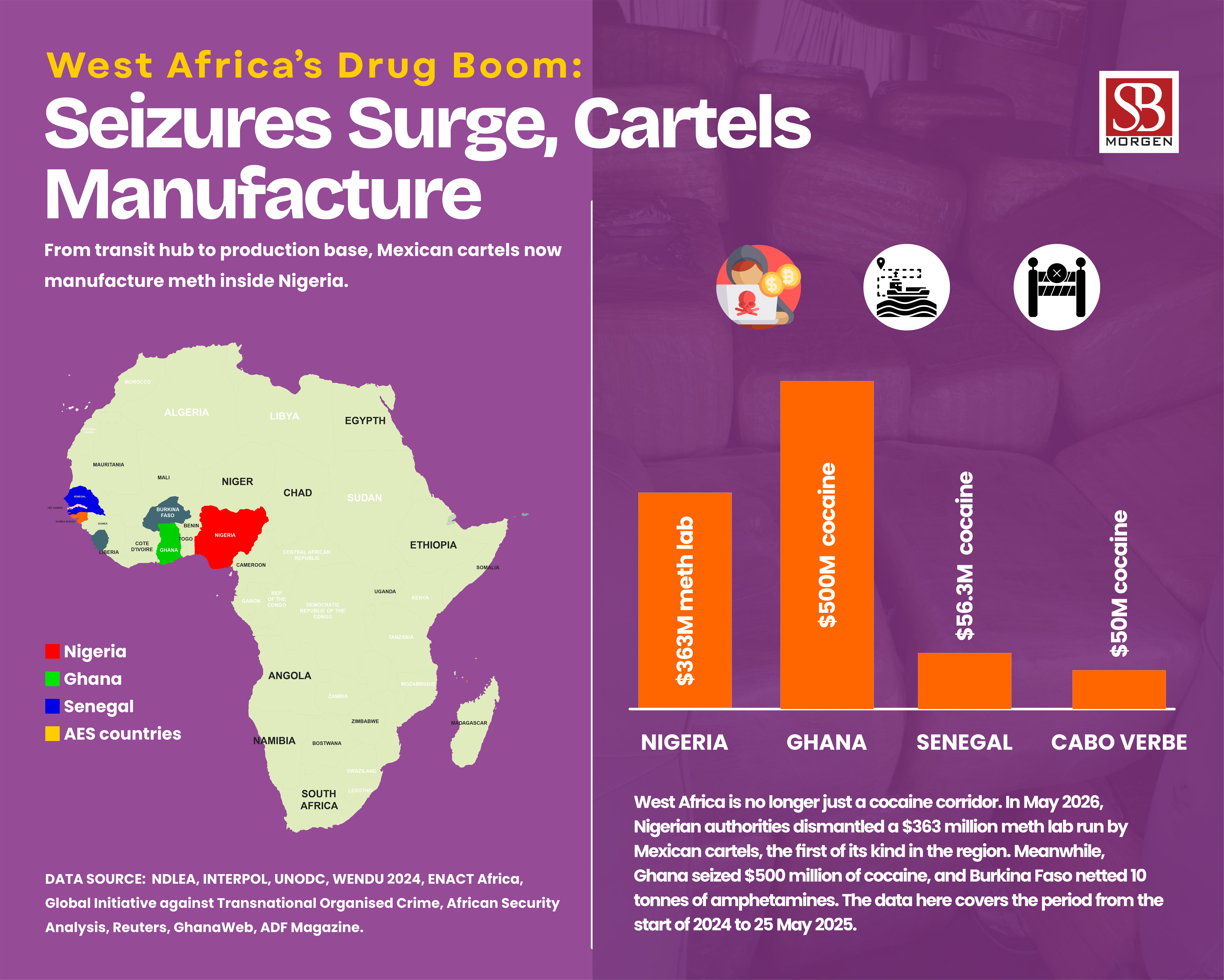
Nigeria’s NDLEA uncovered the country’s largest methamphetamine operation, seizing drugs and chemicals worth about $363 million. Raids in Ogun and Lagos states found a hidden forest laboratory. Ten suspects were arrested, including three Mexican “cooks.” The agency says foreign involvement in Nigeria’s drug trade is growing.
Ahead of Nigeria’s 2027 general elections, President Bola Tinubu secured the APC presidential ticket in a landslide, beating Stanley Osifo with over 10.9 million votes. Peter Obi cleared the Nigeria Democratic Congress screening, while a faction loyal to Dumebi Kachikwu took over the African Democratic Congress and adopted him as its candidate.
Nigeria’s GDP rose 3.89% in the first quarter of 2026, up from 3.13% a year earlier. Services and non-oil sectors such as telecoms and manufacturing drove growth, pushing nominal GDP to ₦110.8 trillion. However, the Central Bank kept its benchmark rate at 26.5% to curb rising inflation.