
The week ahead - Reforming, expanding and dealing
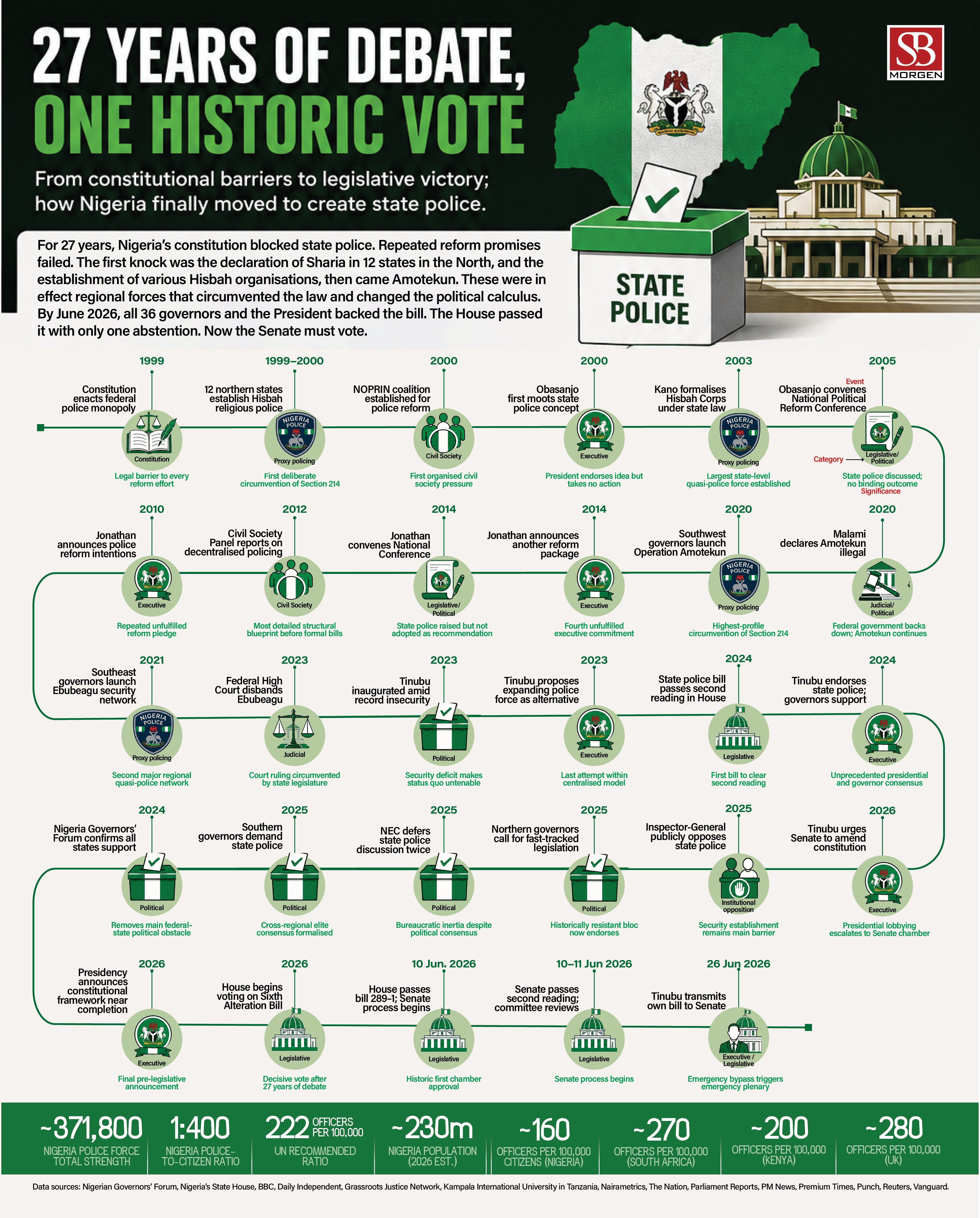
State police clears Senate, Diezani acquitted, US sanctions ISIS, Ekiti votes APC, Ghana hikes bills, Ivory Coast strikes oil.

In a busy week for Nigeria, state policing cleared the Senate; a former minister was acquitted in a foreign land; America sanctioned an ISIS money man; and Ekiti voted APC again. Further afield, Ghana raised electricity and gold transparency; Ivory Coast struck more crude; and China's yuan crept further on the continent. The region is reforming, expanding, and dealing.
Chart of the week
Podcast
You can follow our podcasts by subscribing here. This week, Samuel Atiku joins Veronica as African trade with China deepens as more countries adopt the yuan; Ivory Coast finds new oil that could boost growth and jobs; and Nigeria's Senate passes state police, but will it secure citizens or empower governors?
You can listen to today’s episode here.
Video
What we’re following this week
Nigeria’s Senate has passed a constitutional amendment bill to decentralise policing, allowing states to establish their own police services. The bill requires endorsement from 24 state assemblies before becoming law. Governors would appoint police commissioners, with safeguards against political abuse, while federal police handle terrorism and border security.
The United States has imposed sanctions on Nigerian national Mukhtar Adamu Muhammad and three bureau de change companies in Lagos and Kano for allegedly facilitating financial transactions linked to ISIS. The measures, under Executive Order 13224, are part of a broader crackdown on terrorist financing networks.
Governor Biodun Oyebanji secured re-election in Ekiti State, polling 319,224 votes against PDP’s 40,543 and ADC’s 12,872. INEC reported a peaceful process despite BVAS delays. Opposition alleged irregularities, but observers praised turnout and calm, noting only minor procedural concerns.
Former Nigerian petroleum minister Diezani Alison-Madueke has been acquitted of six bribery charges by a London jury after more than 46 hours of deliberation. The decade-long case ended with her and two co-defendants cleared. The verdict is a significant setback for British anti-corruption authorities.
Ghana’s utility regulator has approved electricity tariff increases of 3.49% and water tariff rises of 0.85%, effective July 2026. The Ghana Gold Board also introduced new rules requiring gold buyers to report transactions within five minutes and maintain detailed records for inspection.
Murphy Oil, in partnership with PETROCI Holding, has discovered oil on the CI-709 block offshore Côte d’Ivoire. The BubaIe-1X well revealed 30 metres of net pay across two reservoirs. Further appraisal wells are planned. The find supports Côte d’Ivoire’s goal of becoming a leading African hydrocarbon producer by 2035.
China’s removal of tariffs on imports from 53 African countries, combined with rising trade volumes, is expected to increase yuan-denominated transactions. Banks are expanding payment infrastructure, and countries like Kenya and Zambia are adopting the yuan to reduce costs, though analysts say it will complement rather than replace the dollar.
Media mentions
It has been a busy week for SBM Intelligence, with the firm’s data and expert commentary featuring prominently across international and Nigerian media outlets covering security, economic policy, and governance. Here is a round-up of the key mentions.
State Police Reform Takes Centre Stage
Nigeria’s Senate's passage of a bill to allow the creation of state police forces dominated the news cycle. In an Associated Press report on the historic reform, Ikemesit Effiong, Partner at SBM Intelligence, provided crucial context on why the bill finally gained traction. He explained that recent mass kidnappings had exposed the “structural deficiencies of a centralised policing framework,” where the federal government’s sluggish response to local crises had become untenable. The Nigerian Tribune also cited SBM Intelligence data, noting that the firm recorded 4,722 kidnapping victims and 762 deaths between July 2024 and June 2025, with ransom payments totalling an average of N2.57 billion, underscoring the security crisis that spurred the legislative action.
Security Fears Reach Lagos
As insecurity spreads from the North-West into the South-West, BusinessDay reported on growing concerns for Lagos, Nigeria’s commercial capital. The article featured data from SBM Intelligence showing the scale of the threat: the firm recorded 4,326 insecurity-related incidents in the first quarter of 2026 alone, highlighting the persistence of threats from terrorists, bandits, and kidnappers. The report noted that this data paints a “grim picture” as criminal activities edge closer to Lagos.
Sugar Tax Eroded by Inflation
In a DW report on Nigeria’s sugar-sweetened beverage tax, Ikemesit Effiong criticised the policy’s effectiveness amid soaring inflation. He stated that the current tax of 10 Naira per litre is “pocket change, not policy,” especially when compared to the WHO-recommended 20% levy. His comments highlighted how inflation is undermining public health interventions and the need for more robust fiscal measures.
Voter Sentiment and the 2027 Election
A video from Nigeria Info FM featured SBM Intelligence’s voter sentiment tracker, which revealed which presidential candidate is leading ahead of the 2027 elections. While the video itself does not contain extensive detail, the tracker has become a key reference point for understanding political trends in the run-up to the polls.
The Rising Cost of a Staple Meal
Finally, the Economist turned to SBM Intelligence’s Jollof Index to examine how inflation is making a staple meal a luxury in Nigeria and Ghana. The piece explained that the index, issued quarterly by the Lagos-based consultancy, tracks the prices of 12 ingredients used to make the dish, from tinned tomato purée to cooking oil. The index has become a key barometer of food inflation and household purchasing power across the region.
Across all these mentions, SBM Intelligence’s reputation for providing rigorous, data-driven analysis on Nigeria’s most pressing issues, from security and inflation to governance and public health, remains firmly established.