
The week ahead - The rising tide
IPO fever, debt fears and an equities selloff grip Nigeria as floods wash coastal West Africa and evacuation flights zip across the continent.

Nigeria’s debt hits ₦40.38 trillion, because why borrow small when you can borrow big? Dangote’s $2bn IPO demand shows investors love refineries, just not the ones that actually work. Stocks decline sharply after having a heck of a year. CBN freezes accounts; Lagos arrests 88. Ghana drowns in 593mm of rain. Ivory Coast floods kill 20 and trigger fears of cocoa price increases. South Africa chases migrants out. Punchline? The only thing rising faster than debt is the water level.
Chart of the week
Podcast
You can follow our podcasts by subscribing here. Nigeria’s borrowing hits new highs as Dangote seeks expansion, while Ivory Coast floods threaten cocoa supplies. Deeper debt or growth? David Olujinmi joins Veronica this week to assess these developments.
You can listen to today’s episode here.
Video
On News Central’s Jasiri: terrorism, banditry, and kidnapping test Nigeria's centralised policing. The provisions of the State Police Bill on command, funding, and oversight are scrutinised. Is the current model still fit for purpose?
What we’re following this week
Nigeria’s domestic borrowing surged 75.6 percent year-on-year to ₦40.38 trillion in May 2026, raising crowding-out concerns. The government is also preparing a Eurobond issuance under the 2026 programme to finance the budget and refinance debt.
Dangote Petroleum Refinery is drawing strong investor interest ahead of its September IPO, with institutional demand nearing $2bn. Valued at up to $50bn, it has also imported its first UAE crude cargoes to diversify its supply amid domestic shortages and to support capacity expansion.
Nigeria’s stock market suffered its worst monthly loss on record in June 2026, with the All-Share Index falling 8.28 percent. Market capitalisation dropped from ₦160.5 trillion to ₦147.2 trillion. A late rebound from Airtel Africa shares offered brief relief.
The Central Bank of Nigeria has ordered banks to immediately freeze accounts of individuals and firms sanctioned for terrorism. In a separate joint operation, Lagos and Ogun authorities arrested 88 suspects, rescued five kidnapped victims, and recovered arms.
Thousands of migrants are leaving South Africa as anti-immigrant tensions intensify following an unofficial June 30 deadline for undocumented foreigners. Police have maintained a strong presence while several governments organise repatriation. At least four foreign nationals have been killed in recent weeks.
Ghana is grappling with devastating floods after recording a historic 593.2mm of rainfall in June 2026. At least 12 people have died, and nearly 500 have been rescued. The engineering institute has proposed a 19-point resilience plan.
Côte d’Ivoire is battling severe flooding after torrential rains killed about 20 people and displaced residents across Abidjan. Blocked drainage worsened the disaster. Meanwhile, persistent rains are damaging cocoa crops with black pod disease, pushing global prices up over 20 percent.
Media mentions
It was another week in which SBM Intelligence’s research output and expert commentary took centre stage across international and Nigerian media outlets covering security, economic policy, and governance. Here is a round-up of the key mentions.
AI Misinformation, the Economy and the 2027 Polls
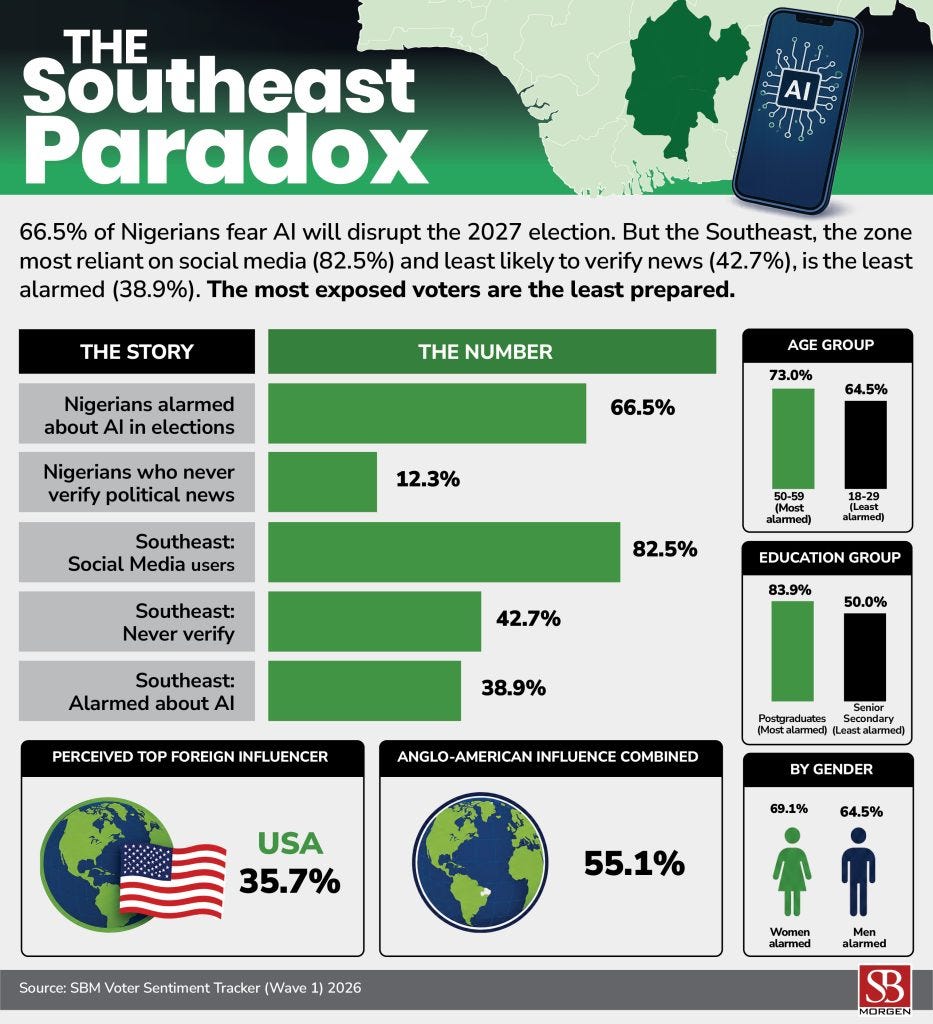
SBM Intelligence’s latest report, The Algorithm and the Ballot Box, sparked considerable debate on the intersection of artificial intelligence and electoral integrity. Based on one of the key findings of SBM Intelligence’s Voter Sentiment Tracker (VST), TechCabal emphasised concerns that artificial intelligence will fuel political misinformation ahead of the 2027 general elections, while Nairametrics and Streamline focused on the implications of the report for assuring market certainty and deepening state fragility. Finally, Bloomberg utilised SBM Intelligence VST data, highlighting President Tinubu’s low approval ratings as emblematic of the disconnect many Nigerians face: macroeconomic conditions improve while prices keep rising.
Nigerian Industrial Policy
In a Punch editorial calling for more policy support for Nigerian manufacturers, the paper relied on insights from Analysts at SBM Intelligence analysts arguing that headline tax cuts for manufacturers do not offset the multiple levies - historic and emerging - that Nigerian businesses face, leading to a situation where compliance costs remain high.
Security in Nigeria’s South-East
A Premium Times special report examined whether Finnish-Nigerian separatist leader Simon Ekpa’s imprisonment in Finland had any tangible impact on security in Nigeria’s Southeast. The newspaper compared media-reported attacks across the five South-east states from 1 January to 21 November 2024 (before Ekpa’s arrest) and the same period in 2025 (after his imprisonment). Premium Times cited data from SBM Intelligence’s Four Years of Disruption’ report to emphasise how the sit-at-home protests, initially intended to demand the release of IPOB leader Nnamdi Kanu, evolved into a prolonged economic and humanitarian crisis that cost the region ₦7.6 trillion from 2021 to 2025.